30:58
yeah
00:19
hello everybody
00:20
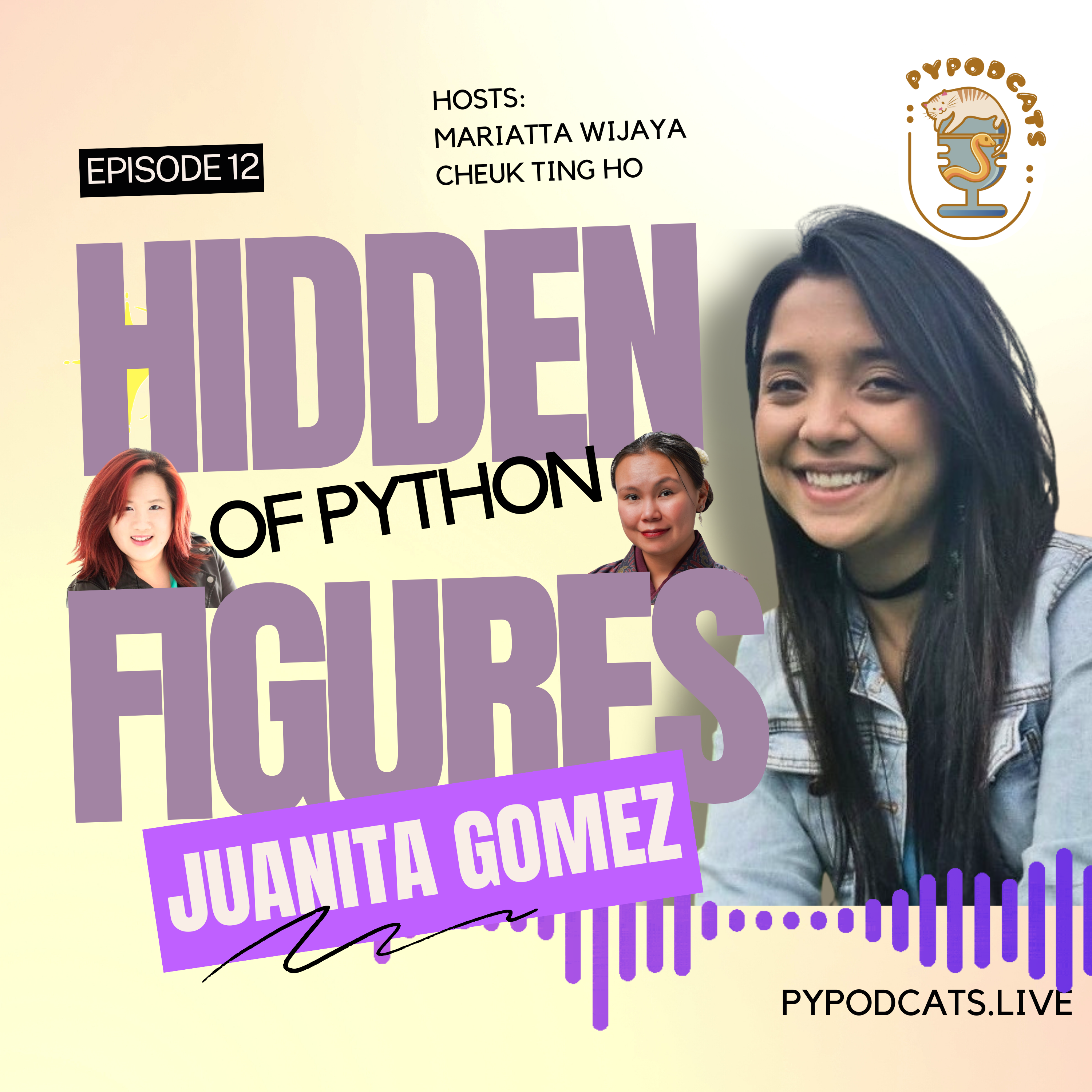
welcome back to another episode of PyPodcats
00:24
The Hidden Figures of Python
00:26
hi everyone
00:27
we are PyPodcats
00:29
and we are doing this Hidden Figures of Python
00:32
because we want to bring more beautiful
00:35
and wonderful people to your
00:38
notice that you know
00:39
that our community doesn't just start from nothing
00:43
we have beautiful and wonderful people building them
00:46
so here we are
00:47
and today we have our wonderful Juanita with us welcome
00:54
welcome Juanita Thank you I'm so excited to be here
00:56
do you want to introduce yourself
00:58
tell us what you do
00:58
so yeah
00:59
yeah so I am currently a PhD student at UC Santa Cruz
01:04
a lot of the research that I do is actually
01:06
related to open source
01:08
specifically security
01:09
that's kind of what I've been up to lately
01:11
but I've been also
01:13
kind of like as a side thing in like my volunteer time
01:16
I've also
01:17
spent a lot of my time with the Scientific Python
01:20
Community
01:21
one of the community managers
01:22
for the Scientific Python Project
01:23
which
01:24
project that is trying to coordinate
01:26
the scientific Python ecosystem
01:28
so we do summits we are writing some specs
01:31
developing tools and yeah
01:33
I'm helping with like a lot of the community
01:35
stuff going on
01:36
sounds amazing
01:38
I guess you're one of these people who send
01:40
Python to Mars right ha ha
01:42
ha ha
01:43
hopefully ha ha
01:45
so I'm actually not in the scientific community
01:48
um I always
01:49
I'm mostly in the web based development using Python
01:53
so it's always amazing because I know there is a huge
01:57
huge community in the scientific
01:59
you know Python
02:00
can you tell us more about it
02:02
like how did you get started into this community
02:05
so it actually goes all the way back to maybe
02:08
5, 6 years ago
02:09
I started as a as a developer for Spyder
02:12
the IDE for Python
02:13
which I think it's actually an IDE that is um
02:16
meant for scientists not necessarily server developers
02:19
but
02:19
it's meant to make your development with Python easier
02:23
I joined the Spyder team a very long time ago
02:26
haha and a lot of the work that I did was actually
02:29
focused on documentation and community outreach
02:32
I started doing events
02:33
I guess um
02:35
I I had this like Spyder cast
02:36
which I guess is kind of similar to what we're doing
02:39
today um
02:40
where I kind of invited developers on stage
02:42
where they only talked about
02:43
um some of the work that they did for Spyder
02:45
and I also started to do tutorials and
02:47
for Spyder
02:47
I guess
02:48
I guess it's a way to reach out
02:51
more people in the community
02:51
But also with this idea of
02:53
kind of
02:53
turning documentation into something more millennial
02:56
like reaching younger generations
02:59
um and
03:00
and the two people who started this Scientific
03:03
Python project which were uh
03:04
were Stéfan J. van der Walt and Jarrod Millman
03:06
they saw some of my work that I was doing with Spyder
03:09
I think they probably saw my YouTube videos and
03:11
amazing
03:12
yeah they reach out to me and they were like
03:15
do you want do you
03:16
do you want to be part of this
03:17
they were just starting they
03:18
they got a grant
03:19
and they were just starting the project
03:21
and they kind of just invited me to join
03:23
and a lot of the work that I did at the beginning
03:25
was actually
03:25
writing
03:26
guides and doing actually like
03:28
videos for beginners to the ecosystem
03:31
that's how I joined
03:32
That sounds amazing
03:33
like I think you showed just like
03:35
there are so many ways to contribute to the community
03:38
like I think writing documentation and
03:41
giving visibility of the project sharing
03:43
you know how other people use that IDE
03:45
it's very important so
03:47
I think it's always something that is so important
03:50
but then a lot of people just overlook it right
03:53
like sometimes you know
03:54
you say like oh
03:55
I have created this functionality
03:56
people be like wow
03:57
and then if you say oh
03:58
I write this documentation
04:00
people like
04:00
ok so I think yeah
04:03
it's like
04:03
but it's very important
04:04
because if nobody is writing any documentation or
04:07
or doing all these work
04:09
that is less glamorous than no one knew
04:12
it's coming to the community
04:13
and it become like a project
04:14
that everybody have grey hair and you know
04:17
nobody
04:18
like the young people doesn't care about it anymore
04:21
you know that
04:21
then the project will probably
04:23
be less popular than what it is so
04:24
yeah and I
04:25
I actually didn't know
04:27
that I was gonna end up doing docs
04:29
when I joined
04:29
I was doing like I was just fixing bugs like any
04:32
any like beginner developer in a project
04:34
and I ended up like involved with documentation
04:38
and I guess my first goal was to make it more friendly
04:39
I guess my like first goal was to make it more friendly
04:41
so a lot of it was like
04:43
literally just putting screenshots and Gifs in the
04:45
the documentation which it was a lot of work
04:47
I thought it was very important to kinda like
04:50
include more people and to make it easier
04:51
to learn how to use a tool
04:53
especially
04:53
cause it wasn't meant for software developers
04:55
it was meant for scientists who don't necessarily know
04:58
um like all the fundamentals of software development
05:01
and I think making
05:02
it easier to use by having
05:04
very good docs was kind of like one of my first goals
05:07
when I hear your story just now
05:09
I like how you mention that
05:11
trying to reach different audience
05:13
different subset of group of
05:15
you know
05:16
people who consume YouTube
05:17
like I think I don't really have YouTube channels
05:20
I tried it's not easy to to run it
05:23
so I think it's amazing that you're doing that
05:26
I'm also not good at that
05:28
I tried
05:28
I won't be a very good Youtuber
05:30
I think I'm just a goofball
05:32
I don't know how to do marketing
05:33
how to like you know
05:34
I kind of analyze what people like
05:36
what people don't like I just do what I like
05:38
and I don't think it's a very good strategy
05:41
funny enough
05:42
the reason that I was able to do a lot of the like
05:44
to do
05:45
editing and like I guess
05:47
the creative part of the
05:49
tutorials and all of these things was because
05:51
I had a YouTube channel that was for music
05:53
so I was like
05:54
I started like when I was in my undergrad
05:57
I started like a music YouTube channel
05:58
so I was like recording songs and doing videos
06:00
like music videos
06:02
and I started a YouTube channel
06:03
so I had to learn how to do video editing
06:05
and that's kind of why I was able to do this
06:07
like it was like just random skills that I picked up
06:09
doing something else
06:10
that I was able to put into practice
06:12
while doing documentation
06:13
yeah so you were already like
06:14
doing music thing before TikTok become a thing
06:17
right now everybody is like dancing
06:20
I don't do TikTok though
06:22
sometimes see people in the in the square
06:24
they were just like you know
06:25
young people they play some music
06:26
they look very cool and like dancing
06:28
and I was like
06:29
I'm so old right
06:30
I'm not used to TikTok I'll be like
06:31
oh that remind me of when I was in uni
06:33
like the dance club people
06:34
and then my friend who is younger was like
06:36
they probably not dance club
06:38
they're just doing TikTok
06:39
I was like what is that
06:41
yeah
06:41
and that's what the younger generations are doing now
06:44
yeah And I actually I didn't do that for Spyder
06:46
but I did some TikToks for the Scientific
06:48
Python project
06:49
and I was kind of trying to figure out what was
06:52
like short enough to put in a TikTok
06:55
that was like educational
06:57
I guess because I mean
06:58
like nowadays
06:59
the way that people consume all of these media is like
07:02
it's very short if you do something that
07:03
it's longer than 1 or two minutes long in TikTok
07:06
they're not gonna watch it
07:07
so you need to like break it into very small pieces
07:08
like it
07:10
so I did some like very basic um
07:12
videos on things like how to do your first PR
07:16
how to review a PR things like that on TikTok
07:18
that was fun but it was very hard
07:21
I think that's very interesting
07:23
we need to find those links
07:24
and share with our audiences
07:26
we need to watch those those TikToks you made
07:28
yeah
07:29
yeah
07:29
I was very skeptical like even a couple of years ago
07:33
uh when I was working at Anaconda
07:34
my colleague at the time
07:36
Sophia she's also very talented
07:37
she did all this like oh
07:38
data science short form video
07:41
I don't know TikTok or YouTube
07:42
whatever
07:43
like teaching people data science
07:45
I was like
07:45
does it work'cause like but well
07:47
it proves that I was wrong
07:48
it works and now I'm like struggling of like
07:51
how can we do that
07:52
hahaha
07:52
yeah I think you just need to go with
07:54
you know what's in these days
07:56
you have to I I realize I'm also old
07:59
like I don't have TikTok account
08:01
but I know that's what the younger people do
08:04
and if we want the Python committee to stay relevant
08:07
maybe we need to start doing this
08:09
we need young people
08:10
yeah
08:11
you know if you ask us to decide on oh
08:14
what to do
08:14
we just come up with something that maybe work like
08:16
10 years ago but not working now
08:18
so
08:18
but anyway let's go back to what Juanita has been doing
08:21
so
08:22
um you also do a lot of security work
08:24
which I think again like
08:25
is something that is very important and it's like
08:28
getting more and more attention these days
08:29
for open source so what made you go into the field
08:32
like is it because you love open source
08:34
you want to do something for it
08:36
or is it just like oh
08:37
security super cool
08:38
I want to do that which come first
08:40
so when I started my PhD
08:42
I was actually I joined the Security Lab
08:45
I wasn't working on open source at first
08:47
and the reason I joined the Security Lab was because
08:49
my background is actually in
08:50
math and I did some cryptography stuff
08:53
so my advisor
08:54
thought that I would be a good fit to do some like
08:56
security
08:57
stuff so at the beginning
08:58
I was actually doing like cryptography things
09:00
not related to open source at all
09:02
so I had this like
09:03
divided life where like during the day
09:05
I was working in security and during the night
09:07
I was working in open source
09:09
um and I thought that wasn't cool
09:11
I thought that
09:11
I would be better if I could merge
09:13
like my passion and my
09:15
research
09:15
so
09:16
I started talking to people at the Open Source Program
09:18
office in my university and I guess they were like
09:21
interested in working with me
09:22
I had a lot of experience in like
09:24
community work
09:25
and like a lot of contacts within the ecosystem
09:27
so I I think that was that was good
09:29
and I think the reason I
09:31
decided to kind of bring security into the open source
09:35
work that I was doing was because I saw like
09:37
a gap
09:38
like by talking to maintainers and to developers
09:41
I realized that
09:42
security is something that people are concerned about
09:44
but they're not necessarily experts on
09:46
they don't necessarily have the time for
09:48
so it's something that it's important
09:50
but it's not addressed
09:51
like as much as I think it should be
09:53
so I think I wanted to bridge that gap
09:55
kind of to just kind of help maintainers with security
09:58
I am definitely not an expert yet
10:00
on
10:01
a lot of what the things that I've been doing is like
10:02
learning about
10:03
what is it that you need in your open source project
10:06
I would say be like more secure
10:09
and that's where I'm headed
10:10
is I want to be able to help maintainers
10:13
I want to I want to work on the human part of security
10:15
not necessarily like bug bounties or
10:19
I don't know like more yeah
10:21
I would say like hacky things but more um
10:23
learning about best practices and security
10:25
and helping maintainers implement those
10:27
best practices in their projects
10:28
I think that's kind of like my goal
10:30
cause I think that would be
10:31
a useful contribution to the ecosystem
10:33
I always like had this image of like
10:35
oh security is super cool
10:36
like you know
10:36
just like what you said the
10:38
you know the bug bounty and stuff is look like
10:40
like Wild West like instead of cowboy
10:42
you have all these like Sci-Fi hero and things
10:44
but then like I think yeah
10:45
it's more serious than you know
10:47
the fantasy world that you have to really
10:50
put your foot down and do a lot of like
10:52
very fundamental work that a
10:54
lot of people don't see
10:56
I just found it very difficult
10:58
that's why I kind of
10:59
uh left that kind of trend on like doing security
11:03
I I'm totally not a very secure person
11:05
I jaywalk all the time you know
11:07
this is like
11:09
not security reasons
11:11
yeah
11:12
I know you still you mention you're like
11:14
you're learning right now
11:15
but is there something actionable
11:18
we can do as an open source maintainer
11:21
to be even more secure right now
11:23
so I think um
11:24
for example github uh
11:26
is one of those places
11:28
that has been helping a lot with security practices
11:31
and I feel like they've made it easier
11:32
for maintainers to implement
11:34
some of their
11:34
like security stuff in their repositories
11:37
I would start with that
11:37
I would start with like anything that Github
11:39
like recommends they have very concise guides on like
11:43
beginner practices I would say
11:45
things like implementing secret scanning
11:47
or static analysis in your repositories
11:50
or like dependency updates
11:52
like automatic dependency updates with dependabot
11:55
some of these things are things that Github has
11:57
I think made very easy for maintainers to implement
12:01
so I would start with that
12:02
but
12:03
another thing that I've been doing a lot with
12:05
the repositories
12:06
so I'm I'm actually working with
12:08
the projects that are associated with the university of
12:10
California system
12:11
that's kind of the population that I'm working
12:13
just because I'm um
12:14
working from the OSPO of the university
12:16
and with other OSPOs
12:18
and a lot of what I'm doing with
12:19
these projects is analyzing
12:21
everything from like health practices
12:23
as in like do they have contributing guides
12:25
do they have issue templates
12:26
all of these things
12:27
all the way to more like advanced security stuff
12:30
and
12:30
one of the tools that I use a lot is the score cards
12:33
from the Open SSF
12:34
which is just a tool that will allow you to
12:36
measure a bunch of different security flags
12:38
in your repositories
12:39
I don't necessarily think that the score
12:42
is important to tell you
12:43
the actual picture of security in your repository
12:46
but it will give you some action items
12:47
so you will see some of the things that you are lacking
12:50
and it will give you some
12:51
good action things to start with
12:53
to increase the security
12:54
or your repository
12:55
I would say
12:56
maybe those two things would be
12:57
uh huh Things that I'm
12:58
Looking into right now
12:59
ya
13:00
so I'm familiar with the Github
13:02
you know
13:02
security checklist and I think it's very important
13:05
the secret scanning I know in the past
13:07
a long time ago I was a newbie
13:09
I committed the secret and I'm glad that it caught it
13:13
so
13:14
but the open SSF
13:16
score card how do we get that
13:18
I know I've heard this before
13:20
but I don't know how it works
13:21
like how do you get scored
13:24
so there's multiple ways of doing it
13:26
I mean if you go to the Scorecard dot Dev website
13:28
they just have
13:29
like a very easy explanation of how to get it
13:31
you can install it as a Github action
13:33
in your repository
13:34
so it would kind of run automatically
13:36
I don't do it like
13:37
that because I don't do it for my own repositories
13:39
I do it for other repositories
13:41
so they also have a CLI
13:42
so you just clone the repo
13:44
install the package
13:45
and you can just run it in your terminal
13:47
like scorecard
13:47
and then you put the link of the repository
13:49
and then it just runs
13:50
yeah like
13:51
like a CLI and they have like different output formats
13:55
so for example
13:56
what I do is I collect everything in JSON
13:59
and then I kind of
14:00
cause I'm running it for multiple repos
14:01
so I just have a python script
14:03
that will run it for all of them
14:04
and then I collect everything in JSON
14:06
and I just do a fancy CSV table
14:08
so I can see the results
14:09
but yeah you can do it as a github action also
14:12
oh I didn't know about this
14:13
I didn't know there was CLI
14:15
we need this run on our repos
14:16
should we actually run it on all kinds of repos
14:19
or is there certain projects
14:21
do you think that maybe more prone to this
14:26
should we run it against our PyPodcats website
14:30
I mean I don't know I'm
14:32
I'm actually also struggling with that
14:34
because I think that there is a lot of the checks
14:36
that scorecards have that
14:38
maybe are not important for
14:39
some types of repositories
14:41
like if it's like a very beginner repository
14:43
then some of the checks might not make as much sense
14:46
so I think it is okay to run it in every repository
14:49
as long as you can
14:51
kind of be objective about knowing what
14:53
the metrics that you are looking at mean
14:55
and how the characteristics of your repository
14:59
like make or not sense with the metrics that you're
15:02
looking at I think
15:03
it's a very cool tool
15:04
just because it will give you some
15:06
things that you can improve
15:08
regardless of what stage is your repository on
15:11
but I
15:12
I think it's something to be careful about that it's
15:14
it might not be like not all of the checks
15:16
might apply
15:17
for the type of project that you're working on
15:19
okay
15:19
now I want to address the elephant in the room like AI
15:22
is it good or bad for security in open source
15:25
oh my God
15:28
I think it could be good
15:29
um for certain things
15:30
I think AI for everything
15:32
it should be used very carefully
15:33
and I think understanding what AI is
15:35
understanding the way I see is part of life
15:36
is part of that it's like understanding that
15:38
it's not like a magician that's telling you answers
15:41
it's just statistics right
15:42
and I think that is part of
15:44
maybe the problem when people like
15:46
use it too much is like
15:47
they don't really know what's behind it
15:49
I've actually done a project with like
15:51
identifying vulnerabilities in code using AI
15:56
and I actually had fairly good results with like
15:58
the newest models
15:59
so I think there is
16:01
a possibility that maybe in the future
16:03
AI could be something very good for identifying
16:05
like
16:06
certain code patterns or
16:07
some of these things that could be dangerous
16:09
for your repositories
16:10
um whether life on that like 100%
16:13
I'm not sure like I wouldn't be like
16:15
oh I give this to an AI
16:17
and then if the AI says this is safe
16:18
then it's safe
16:19
I don't think that would be the way that I would do it
16:21
but I do think it it
16:22
could be a very good tool to uncover some things uh
16:25
like in an automatic way
16:27
now everybody's thinking like
16:28
how AI is gonna change our life
16:30
our profession and everything
16:31
so I have to ask this question
16:33
hmm
16:34
so Juanita I
16:35
I meant you earlier on you talk about
16:38
you know you've been
16:39
been involved in the community side of open source
16:42
you help run
16:43
you know hackathon and things
16:45
do you have some stories to share
16:48
like maybe there are unique events that happened
16:52
or are there certain challenges
16:55
that you'd like to share with our listeners
16:57
um let me think about it
16:59
so I think um I've done
17:02
like helping organize summits
17:04
for the Scientific Python Project
17:05
so we we do like a yearly summit with maintainers
17:08
this is has been only going for like three years
17:11
and I was
17:12
I was there for the first summit and it was a very
17:14
like a new experience for me to just kind of
17:17
figure out what you need to organize an event with like
17:20
the community
17:20
I think that maybe one of the challenging things from
17:24
from this is like how do you make people happy
17:26
cause you're like inviting them to uh
17:29
be in like a week or just like working on open source
17:33
which is already what most of them do
17:35
but it's like
17:35
they have to travel and they have to like
17:37
spend like a lot of their time
17:38
and like a lot of
17:39
cause it's more like a hands on thing
17:41
and I think things like
17:42
you need to find where they're gonna have dinner
17:44
And you need to find the food and like all of these things
17:45
and like all of these things are things that you maybe
17:48
you don't imagine that you have to plan
17:50
when you're organizing an event
17:51
but then it's like
17:51
people have to eat and you have to find them a hotel
17:54
like on all of these things was definitely challenging
17:57
and then I've also
17:58
being part of the organizing committee for SciPy
18:00
the the conference
18:01
and I'm in the like the communication side of it
18:05
so I help a lot with the social media outreach
18:08
that's kind of
18:09
what my main focus has been for the past three years
18:11
I've also seen you singing on stage for SciPy
18:15
oh yeah
18:17
yes
18:17
I don't know if we have that recording
18:19
yeah there's there's recordings for sure
18:21
we have a group that we call SciPy 5
18:24
and we make it part of the Lightning talks
18:26
so at the end of the conference
18:28
the last lightning talk is like a song
18:29
so we
18:30
we use
18:31
different things that have happened
18:33
during the conference
18:34
and we like create a song with it
18:36
wow And then we just sing a song at the end of the conference
18:38
it's hilarious
18:39
it's been one of the most fun experiences to do in SciPy
18:42
and I think SciPy is one of those conferences where
18:44
beautiful places in the world
18:46
I've been in other conferences
18:47
but I would not do that like
18:49
I would not put myself on a stage and sing a song for
18:52
like the conference
18:53
but SciPy is a very cool conference for that
18:55
I haven't been to SciPy so that sounds
18:58
that sounds fun
18:58
I think we need to bring more of this to other make
19:02
let's make other conferences fun as well
19:05
I haven't been to PyCon
19:07
okay you have to come
19:09
come to PyCon yeah
19:10
you need to stay on stage for us
19:13
You have to sing on stage
19:14
cause we have so many like
19:15
musical talents in the coredev team as well
19:17
I remember they produce a record for the PyLadies auction one year
19:21
so maybe you can you know
19:22
kind of have a jam session
19:26
that would be fun I would love to go to PyCon
19:28
um yeah
19:29
I think
19:29
you know SciPy and PyCon
19:31
you know all these community things great
19:33
but I know it's not always
19:34
you know sunshine and rainbows
19:35
you know
19:36
cause Mariatta can resonate right
19:37
like in open source you know
19:39
there's still like only around 10% of women and like
19:42
you know also security
19:43
I don't see a lot of women in security
19:45
as cyber security either so how do you navigate that
19:49
like
19:49
like what challenges do you face when like being
19:52
you know
19:52
a member of the underrepresented group in the industry
19:56
yeah
19:58
I guess my biggest challenge is the imposter syndrome
20:01
of like
20:02
feeling that I'm not good enough to be part of like
20:05
this community
20:06
I guess not necessarily
20:07
because I'm in an underrepresented community
20:09
but also just because my background is very different
20:11
like I didn't come from software
20:13
I actually come from math
20:14
so I feel like sometimes I lack a lot of these basics
20:17
and I also think that this challenge is like
20:19
I haven't had that a lot
20:21
but there's definitely been some
20:23
situations where I feel like I've
20:24
I've been treated differently
20:26
because I am part of an underrepresented community
20:29
I'm both a woman and Latina
20:31
so I'm doubly underrepresented
20:33
and I think
20:34
I think it's it's been tough in some situation
20:37
but at the but at the same time
20:38
it's make me want to work harder
20:41
I mean to prove myself
20:42
but also to represent the communities
20:45
right
20:45
to like to make sure that people know that women are
20:47
to make sure that people know that women
20:49
can also be great at their jobs
20:50
can also be great coders can also be great at
20:53
at managing people like all of these things
20:55
so I think it's
20:56
it's inspire me to work harder
20:57
maybe some of that comes from my own
20:59
like insecurity and imposter syndrome
21:01
but I think the consequences are good
21:03
I think the consequences of like
21:04
working harder
21:05
and trying to achieve more and grow more are
21:08
are always good
21:09
and I also think that
21:11
I mean one of the ways that
21:12
I guess I navigate that is by
21:14
getting closer to people who will inspire me
21:18
and will
21:19
I guess elevate my work
21:20
and I think the open source community
21:21
I think the open source community
21:22
the Python community the scientific Python community
21:25
it's full of those people
21:26
it's full of people who will
21:27
tell you all the time how good of a job you're doing
21:30
and will elevate you
21:31
and will teach you and will mentor you
21:33
and I think that's been like
21:34
the most important thing for me
21:35
is to surround myself
21:37
with the people that will allow me to grow
21:39
and not
21:40
kind of push me down
21:41
that's really important and I love hearing this
21:43
ya And I feel like a lot of us can really
21:46
relate and resonate with what you
21:49
you know what you experience
21:50
I do believe that it's
21:51
it's very important to find the right
21:53
of the right community and I do
21:56
I agree like
21:57
the Python community is kind of special in that
22:00
you can always find someone like
22:02
I feel the whole community is always there
22:05
wanting and willing to help you and support you so
22:08
and I think you mentioned a very good point
22:10
like imposter syndrome
22:11
because I don't know when I meet you maybe
22:13
maybe like you know
22:13
a little bit before SciPy or
22:15
or SciPy I can't remember
22:16
but like
22:16
we met in Colombia
22:17
Maybe oh maybe PyCon Colombia yes
22:20
yeah but when I look at you
22:21
it's just like oh my God
22:22
you're so amazing so confident and so many talent
22:25
and I feel like
22:26
even if you say that you have imposter syndrome
22:28
I I'm pretty sure that a lot of people in the community
22:31
will feel the same you know
22:32
like
22:32
so sometimes you know
22:33
is sometimes you know
22:34
um yeah
22:35
finding a
22:36
supportive group that you can just be open about it
22:39
and like you know
22:39
that is very
22:41
that's that's very valuable
22:42
yeah and I feel like for me as well
22:45
one of the reasons I feel like
22:47
I'm not good enough is because I don't see a lot of
22:51
people who look like me you know
22:52
people I who I can relate to
22:54
and sometimes you feel like you just question yourself
22:57
like
22:57
am I really really good am I here because I'm good
23:00
or am I here just because
23:02
they need to feel in somebody
23:04
you know
23:05
um I
23:05
I think that's still a challenge that I
23:07
personally face I don't know about you all
23:09
yeah no for sure
23:11
I always feel like a lot of times
23:12
like
23:12
we trying to compare things that are not comparable
23:16
like
23:16
I've seen a lot of women in tech
23:18
they do a lot of very important role
23:20
they take on very important role
23:21
doing very important work
23:22
but maybe they are not always those like shiny and like
23:26
you know work that admire by a lot of people
23:28
so
23:28
it's unfair to compare like
23:31
those people's achievement to the more typical
23:33
people's achievement and I think that's
23:36
you know
23:36
sometimes make you feel a bit underwhelmed of your
23:39
what you have done so yeah
23:41
yeah that's true
23:42
and I think when I first joined the Spyder Team I
23:44
I was actually the only woman
23:46
and that was a lot of responsibility for me
23:49
like
23:49
I felt like I was representing women in the team and I
23:53
I had to kind of put the face of like what
23:56
what women can do um
23:58
that was a lot of responsibility
23:59
but it was
24:00
I think it was also a very good experience for me to
24:04
like
24:04
you know like just learn that I can do all these things
24:07
at the beginning
24:07
I wasn't a software developer
24:09
when I got invited to be part of the Spyder team
24:11
and I was like I don't know if I can do this
24:12
but just
24:13
joining the team
24:14
and being part of a community that wants to help you
24:17
and mentor you
24:17
I think that was
24:18
that was a great experience
24:19
and it's good that you bring those like
24:21
experience and to kind of help other people as well
24:25
uh huh
24:25
thaat's great yeah
24:26
I'd like to hear more about your
24:29
you your other YouTube about singing haha
24:31
can you tell us more about it
24:33
can you have a links to share haha
24:36
should we subscribe to it
24:38
yes yes
24:39
yeah so I
24:40
I actually started singing when I was very
24:43
very little
24:44
like in like maybe choirs and
24:47
and bands and stuff like that
24:48
and actually when I was like 12 years old
24:50
I went to The X Factor in Colombia and um
24:55
wow I passed a few rounds then they kicked me out
24:58
and I remember one of the judges told me like
25:00
you have a very pretty voice
25:01
but you need
25:02
you need to study cause you don't have enough
25:04
like volume and enough like projection of your voice
25:07
and that was for me
25:08
like that's what made me want to become better
25:11
so as like as after I got kicked out of The X Factor
25:15
I went and I started studying music and taking like
25:18
vocal technique lessons
25:20
and I guess I I yeah
25:21
I started becoming better and I think after yeah
25:24
so when I was in my undergrad I started this project
25:27
I created a YouTube channel and I started uh
25:30
recording and doing videos
25:31
it was always covers
25:32
I've never been like writing my own music
25:35
but it's it's been always like covers
25:37
um but it was like a lot of work
25:39
so after maybe two years I was like
25:41
I don't think I can do this as much so I
25:44
I have a YouTube channel with a lot of videos
25:46
but I haven't done much in the past few years
25:49
and I also have played with like different bands
25:52
so before I
25:53
I moved from Colombia to the US like four or five
25:56
years ago and before I moved I was uh
25:58
singing with a band and we had some like
26:00
concerts and things like that
26:02
and that was very very fun
26:03
and now I'm in the US and it's a little bit harder
26:05
and I
26:06
I not necessarily have found the right people haha
26:09
to do music
26:10
but it's something that I definitely still have in me
26:13
like I think music is one of those things that I
26:15
I never leave behind and
26:17
the first thing I bought when I got here was a guitar
26:20
and then I bought a piano
26:21
a keyboard it's right there
26:22
oh
26:24
yeah
26:26
and it's like one of those things that I feel
26:28
feels my heart with joy so it's
26:31
I guess it keeps my mental health
26:33
and
26:34
it's something that I like to share a lot with people
26:36
too
26:36
so just like singing for people
26:38
playing for people is something that I really
26:40
I really enjoy doing too
26:41
I have to break a news for you
26:43
cause this year in Europython
26:44
they have formed a band
26:46
so
26:47
oh wow
26:47
yes it started with
26:49
you know I don't know if you know him
26:51
our friend Moses like he perform a little bit of like
26:54
you know a music at
26:56
at the lighting talk just like you do
26:58
you know it's just a little bit fun music
26:59
and then it grow and grow into like
27:01
there are more and more people joining him
27:03
and they will bring their musical
27:05
instrument to EuroPython and this year
27:07
if you look at the recording
27:08
like they perform all together on stage
27:11
that's amazing so
27:12
um just so you know
27:14
you can come to EuroPython and jam with everyone
27:18
they would love to have you
27:19
I would love to do that
27:20
I think it's uh
27:21
for me I'm just
27:22
I really admire that like I
27:24
I admire your you know
27:26
like rejection not rejection
27:28
like you got kicked out
27:29
you mentioned you got kicked out from something
27:31
but you took it as motivation to make you even better
27:36
I think that's really inspiring
27:38
like congrats for doing that
27:39
some people thinks like once they fail at something
27:42
they give up they don't wanna do it anymore
27:45
but you continued on to do it so it's really cool
27:48
when I was a kid I wanted to be Shakira
27:51
to be what
27:52
Shakira
27:53
oh yes I love her music
27:55
yes yes yes
27:56
I was like is everybody in Colombia so talented
27:59
I think so
28:01
yeah
28:02
I wanted to be her when I was a kid
28:04
I thought I was gonna like
28:05
follow that path and study music
28:08
and just become a musician
28:09
like be a singer
28:10
I'm glad I didn't
28:11
because I think that I would have missed
28:13
on all the other side of
28:15
the work that I do and the things that I do
28:17
that are also very close to my heart
28:19
but I yeah
28:20
it's funny cause I
28:21
I really thought that that's what I was gonna do
28:23
yeah I do enjoy going to
28:25
dancing with the organisers of PyCon Colombia
28:28
that's
28:29
that's amazing I was like
28:30
I won't struggle cause a lot of times we say like
28:32
oh like if you go to PyCon or like
28:35
we are just a bunch of nerds
28:36
we don't party we don't dance
28:37
no look at that I mean like
28:39
mm hmm mm hmm everybody dance we're cool nerds
28:41
hahaha yes hahaha
28:44
we also dance a little bit
28:45
like at the social event of PyCon Greece
28:47
I think at the end
28:48
usually it's like people need to really like
28:51
you know
28:51
warm up
28:52
spend lots of time to warm up until they will be like
28:54
okay now we can dance
28:55
but like I like in
28:57
in Colombia
28:57
it's just like everybody just like right away
28:59
you know let's dance
29:00
you know like
29:02
we're very warm
29:05
that's just yeah
29:07
another thing that I I really miss
29:08
I have
29:08
I really miss PyCon Colombia that that was really
29:11
really fun experience that was
29:13
I miss the community there
29:15
they are just amazing yeah
29:17
oh yeah
29:17
or do you have any other topics we want
29:19
you want to talk about before we wrap it up
29:21
um no
29:23
I would say thank you so much for inviting me
29:25
and I really feel very grateful to be part of um
29:29
the Python community the
29:31
the Python community the scientific Python community
29:34
the open source community in general
29:35
and
29:36
I really love the work that you two are doing
29:38
in elevating the people from the community
29:40
and showing the work that they're doing um
29:42
to the world
29:43
cause I think that is a very important part of
29:45
of being part of of this
29:47
you know of
29:47
of feeling that the work that you're doing counts
29:50
and that people um
29:51
appreciate it
29:51
so I'm really grateful that you invited me and
29:54
and yeah I hope you keep up the
29:56
the good work cause I'm I'm really yeah
29:58
I really like what you're trying to do
30:00
thank you Juanita
30:01
thank you for joining us we're really grateful to hear
30:04
and I think your story is really inspiring
30:06
so yeah thank you so much
30:07
yeah so thank you so much for inspiring all of us
30:10
if you who are watching
30:12
if you want us to inspire more people
30:14
please uh
30:15
consider donating to PyPodcats
30:17
uh because
30:18
you know to produce this kind of
30:20
episode uh
30:21
it's not like running a conference
30:22
it's not as expensive
30:23
but it still require money to have all this equipment
30:26
we are not monetizing our videos or podcast
30:29
so we need your uh donation to support us to
30:29
we need your uh donation to support us
30:32
you know
30:33
keep doing this and inspire more people and um
30:36
just
30:36
give people who have been
30:37
people who have
30:38
doing so much hard work for the community a shout out
30:41
so people know about them
30:43
thank you so much for watching
30:44
and this is Juanita amazing
30:47
thank you
30:50
hope to see you
30:51
again next time in our next episode of PyPodcats
30:54
Hidden Figures of Python
30:55
thank you everybody bye
18:44
people really have a lot of fun with that