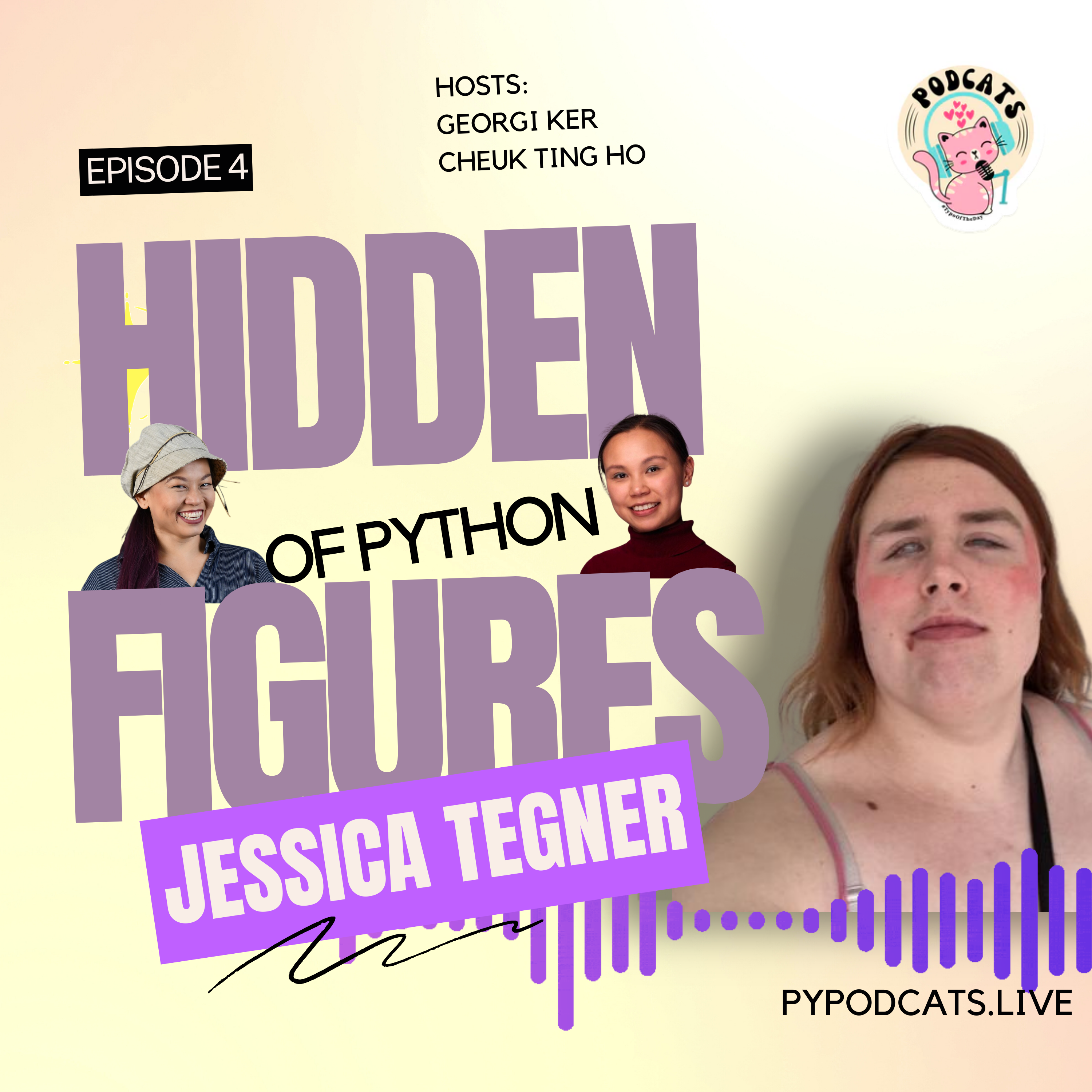
00:21
Hi, everyone.
00:22
Welcome to PyPodcats, the Hidden
00:25
Figures of Python podcast series.
00:27
The PyPodcats is a series that is created
00:31
by me, Georgi, and here there's Cheuk, Tereza, and
00:35
Mariatta, all four of us coming together to highlight
00:38
voices from under-represented group members of the Python community.
00:42
Now we follow the PSF Code of
00:44
Conduct to help interactions and to keep
00:46
Python a positive, successful, and growing community.
00:50
If you would like to know more about the
00:54
details of the Code of Conduct, you can head
00:57
out straight onto https://pypodcats.live/conduct
01:04
A little bit of self introduction.
01:07
My name is Geogrgi and I am
01:10
hosting today live at Porto, Portugal.
01:14
Normally I'm in Amsterdam.
01:17
And to you, Cheuk.
01:19
Hi, I'm Cheuk and I live in London.
01:22
I love Python.
01:23
I am a PyLady. I don't know.
01:26
Yeah, I'm addicted to Python.
01:28
Then we have our guest today, Jessica.
01:31
Hello, Jessica.
01:32
Hello.
01:33
Yeah, so thanks for having me on, you two.
01:36
Yeah, my name is Jessica.
01:38
I'm a open source maintainer primarily
01:43
of like, different Python projects.
01:46
I am in Denmark right now, but I love
01:50
to travel and I love to go to different
01:52
conferences, mostly as a speaker, but I also really
01:56
want to just go to more as an attendee.
01:58
So I'm all over the place.
01:59
But, yeah, right now I'm in Denmark, where I live.
02:04
Super.
02:04
So actually, our first question was
02:07
to ask Jessica to describe herself.
02:10
I think she literally described herself already.
02:13
So we are going to skip the first question.
02:17
Yeah, actually, Jessica and I met in a
02:19
conference in Bilbao and she was speaking there.
02:23
So, yeah, it was my first time speaking
02:27
and I had two lovely talks there. It was great.
02:31
Wow.
02:31
So from the first time you spoke until
02:34
now, how many talks have you given?
02:38
So at physical conferences, I have done those two.
02:43
I've also done a few, done a few interviews and
02:47
I've done a few live streams with some other people,
02:50
and I'm working on a lot of different stuff that's
02:53
coming in the next weeks and next couple of months.
02:57
Well, sounds like a very busy schedule.
02:59
Yes, it is.
03:03
So let's like, rewind, rewind all
03:05
the way back to the beginning.
03:08
How did you first get in contact with a computer?
03:12
Yeah, how did I first get in contact?
03:14
Leave aside.
03:15
Yeah, I feel so old.
03:17
But then, then yet again, not really.
03:20
So how did I first get in contact with a computer?
03:23
It was like mini probably.
03:25
I lived at home.
03:27
I was, what, five or six when I
03:31
started playing video games on the computer.
03:36
I started playing age-appropriate, I want
03:38
to say age-appropriate video games.
03:42
It was age-appropriate.
03:44
Oh, I play a lot of age-
03:47
inappropriate video games when I was little.
03:49
No, but it's mostly, it's like there's a lot of
03:53
video games where people in their start scenes will play
03:55
them even though they are rated for like 16 or
03:59
18 plus, which is what I did at the time.
04:07
It's totally innocent.
04:10
Also, Jessica is very young, so like,
04:12
probably it's easier to like, have a
04:15
computer at home when you're younger.
04:18
When I say video games, when I say video games,
04:21
it was very much, it was very much like very
04:25
basic, like images on the screen, you click on things,
04:28
they do flashy things, and that's it.
04:30
It wasn't anything near as realistic as they are now.
04:34
Not Tetris.
04:36
It was like, I want to say worse than Tetris.
04:40
It was worse than Tetris level.
04:42
I said it was the Family computer on the Small,
04:46
like on the slow dial-up connections that I was.
04:49
That was great.
04:55
We all have memory of those and you
04:57
have to fight over the phone line.
04:59
You have to like ask your mom to not
05:01
use the phone while you're on the Internet.
05:04
Yeah.
05:04
The great thing was that I mainly played offline games,
05:07
so I didn't care about my mom having hour long
05:10
conversations with the rest of the family over the phone.
05:13
That is great.
05:15
Yeah, but yeah, I fell in love from the very
05:19
first moment I really got to use a computer.
05:21
They had to sometimes drag me away from it.
05:27
So how do you actually start coding?
05:29
Like writing, learning how to
05:31
program and stuff like that?
05:33
Yeah.
05:34
So now I'm really going to age myself a lot.
05:38
Honestly, it's not really a secret how old I am.
05:41
It's very out there.
05:43
So around 14 years ago, when I
05:46
was a little girl at ten years.
05:48
Old, not that old.
05:51
I know. Do the math.
05:52
I already have one midlife crisis,
05:54
so you can do the math.
05:57
I started playing a very blocky
05:59
game that many people probably know. Minecraft.
06:01
Oh, yeah.
06:02
And me and my friends had a lot of fun with
06:05
it, like when we were sitting together, but we wanted to
06:08
be able to play together when we were not physically together.
06:11
So I looked into how to make a server for us.
06:15
So we just started playing on a server normally,
06:17
and then we thought it was really fun to
06:19
build stuff and host games and so on.
06:21
So we started opening it up to the public.
06:24
And a year, one and a half years later, we
06:26
were running one of the biggest server networks here in
06:29
Denmark with 3400 concurrent players doing peak hours.
06:35
And that included me.
06:38
I was the Primary tech,
06:39
I was the only tech person more or less
06:41
Primary to only.
06:44
Primary only tech person.
06:46
So I had to learn a lot about networking.
06:48
And then I saw a lot of international videos
06:53
of people playing Minecraft as well, where they played
06:55
on these big servers that had custom stuff.
06:58
And I was looking at it and I was
07:01
like, how can I make stuff like that?
07:03
So I looked into it and I saw there is, there's
07:06
like this entire server modding, like you could write plugins in
07:11
Java to the server where you could add custom logic.
07:15
And then from that I just started learning programming.
07:19
And now again, just like the original, falling in love
07:23
with the computer, I fell in love with programming.
07:25
Oh, that's cool.
07:26
And then how did it step into like Python?
07:30
Well, great question, fast forward
07:37
another three or four years.
07:40
Me and my friends were getting older, we
07:43
kind of started losing interest in Minecraft.
07:45
And I also coded a lot of Minecraft
07:47
related stuff, again mostly for the server side.
07:52
But I wanted to get into more
07:54
general programming because I really loved learning
07:57
about tech, I really love programming.
07:59
I figured I wanted to make desktop applications because I
08:02
was on a computer, I could use a computer.
08:04
So I wanted to make stuff that
08:06
I could use on the computer.
08:07
And I started trying to do that
08:09
in Java and it, it worked.
08:11
I'm very impressed that I got it to work, but it
08:14
worked, but it was very clunky and I wanted something better.
08:17
So I researched it and Python immediately came up and
08:20
I looked into UI libraries and I looked into auto
08:25
updating of like desktop applications and stuff like that.
08:28
And then I tried writing my first program
08:31
in Python that just did something simple.
08:33
I always started with a calculator and then
08:35
I converted it into a UI calculator.
08:39
It's all in Python with auto updating.
08:41
I was super proud of myself.
08:42
And then it just took off from there
08:44
and it spiraled completely out of control into
08:48
this thing I've gotten myself into now.
08:52
Yeah, so you have the Pypandoc, right?
08:55
Or you're like taking someone's
08:57
project and maintaining it.
08:59
Yeah, I took it over. So,
09:02
Yeah, I took it over.
09:04
Could you tell us more about Pypandoc?
09:07
Because I also don't know much about it and
09:10
where you're maintaining this library, so you must know.
09:14
Yeah, sure.
09:15
So there is a CLI tool called Pandoc that is
09:20
a universal document converter that uses the markdown markup format
09:25
to convert between any other, more or less any other
09:28
format you can think about anything from HTML to word
09:32
to PDF to PowerPoint to Wiki to open document formatted
09:38
All the different formats you might want to use,
09:40
and then you have markdown as the intermediary format where
09:44
you actually write your document contents.
09:47
Of course, Python, we love having
09:50
Python libraries to do everything.
09:52
We don't want to call external stuff if
09:54
we have a Python library for it.
09:56
So way back when, when, I wanted to make a
09:59
text editor for the blind, because I myself is totally
10:03
blind, so I wanted to make a text editor where
10:06
I could control the visual formatting much, like much better
10:10
than I could at the time, in, people at the
10:13
time couldn't word or other like mainstream text based.
10:18
Yeah, um, take big editors.
10:21
And it was also before like stuff like VS Code
10:23
and stuff like that really came out.
10:25
So I found Pypandoc, which was
10:27
this Python wrapper around Pandoc that made
10:30
it easy to work with from Python.
10:33
And I utilize, I utilized that
10:35
to basically power my text editor.
10:38
And then I saw that he wasn't updating it
10:42
anymore and I started making more and more like,
10:45
issues and pull requests that got accepted.
10:48
But like, he had kind of like
10:50
not worked on it for a while.
10:52
So I just at one point emailed him and
10:54
asked, hey, if you're not planning on updating it
10:56
anymore, is it okay if I take it over?
11:00
Because I can see it's still very widely used and
11:03
I love it and I would love to maintain it.
11:04
And he was like, yeah, sure, I'm
11:06
just gonna talk to the other maintainer.
11:08
He was also okay with it.
11:10
And then they transferred the GitHub repository and
11:13
the Package Index publish rights to my account
11:18
and the rest as you see is history.
11:20
Yeah, that's really cool. Yeah.
11:24
I mean, being, even, to like, normal, any one of
11:30
us being a maintainer is already really tough, but like,
11:34
you not being able to like, see and still being
11:38
able to maintain the whole project, that is like so
11:43
inspiring for so many people around there, you know?
11:47
Yep.
11:48
I'm just curious, despite all these challenges, how do
11:50
you continue to learn and like to, to improve?
11:55
Are there any like, difficulties or
11:58
things like that along the way?
11:59
When, when there's text based
12:01
tutorials, always the best.
12:02
Because I read approximately twice as fast as
12:06
the, as an average human reader, I read
12:08
around six to 700 words a minute.
12:11
So I can take in information
12:13
Four times faster than me.
12:18
Yeah, YouTube can only allow three times speed.
12:20
It's not fast enough.
12:23
Fair enough.
12:25
So when there's text based tutorials for stuff,
12:27
I can take in information really fast.
12:30
Generally speaking, I haven't had a problem learning because
12:32
there's a lot of books on the topic.
12:34
There's a lot of articles on
12:35
the topic that I've been consuming.
12:38
Mostly articles.
12:39
Not really a big book person, but many,
12:41
many articles, many tutorials and just experimenting.
12:45
Recently, though, what I've gotten into is a little
12:47
more graphical in nature, so that's a little more
12:51
difficult, but I'm getting the hang of it.
12:53
Wow.
12:55
Yeah.
12:55
I also heard from Cheuk
12:58
that you've contributed to Poetry.
13:01
So could you just tell me a little bit
13:03
more about your contribution and what is Poetry?
13:06
So Poetry is a dependency manager and
13:11
a build tool all in one.
13:14
It basically wraps around and makes
13:18
virtual environments for all your projects.
13:20
You have this Poetry file where you can add
13:22
an update dependency with a CLI command, and then
13:25
you can build and publish your packages to the
13:28
Package Index or a custom index.
13:30
All from Poetry.
13:32
So it's a CLI tool, like many, like others, but it's
13:36
There's a bunch of them these days.
13:38
But Poetry, at least what I found was really
13:41
the first big one to, like, break through, really
13:44
was what other people were using, other than the
13:46
combination of pip, virtualenv and setuptools.
13:51
I'm kind of, like, very interested in your
13:54
experience because, like, I am pretty sure that
13:56
your experience is very different from mine.
13:58
Like, from, like we said that we play video games when we
14:01
were a kid to, like, maybe now we go to conferences.
14:04
When you talk about you play Minecraft,
14:06
I'm quite interested about, like, how the
14:09
experience, because from my experience, Minecraft, you
14:13
know, you have to control your character.
14:15
You have to, like, build this
14:16
block and things like that.
14:18
But for someone who uses screen
14:20
reader, like, what's your experience?
14:22
You found it, like, very easy or very
14:24
hard to control or, like, things like that.
14:27
Yeah.
14:27
So the little extra nuance was that I lost
14:32
the rest of my sight when I was 18.
14:34
So in 2018.
14:38
So back in the day when I, when I
14:41
was playing Minecraft, I could see a little bit,
14:43
like, we're still talking like two or 3%.
14:46
So it's like nothing groundbreaking, nothing new,
14:48
getting a driver's license or anything.
14:51
But I could see enough.
14:52
And that was important because Minecraft by nature
14:56
had very high color contrast, like, unintentionally.
15:00
So it was much easier to see and
15:03
play around with compared to many other games.
15:05
Yeah, right.
15:07
I know some games now, they have this, like,
15:09
high contrast options for folks who need high contrast
15:13
as well, but unfortunately, not all of them has.
15:16
It's just like other technology, like, you
15:18
know, websites, some of them are screen
15:20
reader friendly, some of them are not. Really.
15:22
Yes, exactly.
15:23
Yeah.
15:24
But how about conferences like is it?
15:26
You know, I guess it must be, like, very challenging for
15:30
you to, you know, be far away from home and, you
15:33
know, go to a event that is full of people, but
15:35
maybe not everybody knows your need and stuff like that.
15:38
So I'm lucky that a lot of things working for me.
15:43
I love traveling.
15:44
First of all, I love, especially traveling
15:48
by plane is I love that.
15:50
The second is I'm a huge extrovert.
15:52
I'm pretty sure Cheuk can
15:54
Oh, we can hear that and see that.
15:56
I'm pretty sure.
15:57
I'm pretty sure Cheuk can sign off on that.
16:01
You saw me be around people in Bilbao
16:04
So we were having fun at
16:06
the cocktail party, like, you know, the drinks
16:10
party that we have so many Spanish food.
16:13
And yes, it was an interesting experience.
16:21
Okay, sounds like there's some brackets behind.
16:26
So I'm also curious.
16:28
When you're talking about attending a conference,
16:30
like, before you attend a conference, do
16:32
you actually, like, read to see if
16:34
they have specific, like, accessibility?
16:48
This has been the entire freaking day.
16:54
I'm not very good with
16:57
so accessibility, it's okay.
17:01
Like, do you actually read like, and
17:04
check before you attend any conference?
17:06
Like, okay, are they friendly to people with
17:09
disabilities or is there any actually, do you
17:13
read, like, before you attend a conference?
17:15
You know, I always try to find something, or
17:19
Yeah, I always try to find something, but it's very
17:22
rarely, if at all, they ever have it publicly available.
17:26
They,
17:26
I've never seen a conference where they have
17:29
this accessibility info readily available for what they
17:32
do with people that has physical disabilities.
17:38
Yeah, I resorted to just writing them an email.
17:44
So far that's been very successful.
17:47
Also to let them know that you're coming
17:49
and that you're like, in my case, that
17:50
I'm fully blind and, yeah, that I'm attending.
17:54
And I was like, in my case,
17:55
that I'm a speaker or whatever, whatever.
17:57
Just like, hey, can we do something?
17:58
Can we figure something out?
18:00
And yeah, they've always been very good at
18:04
the whole accessibility, but I just wish that
18:07
that information was more readily available.
18:10
So people that maybe not was as just like,
18:13
out there going as I am also know that,
18:16
hey, there's actually things that they're going to do.
18:20
Yeah, that's true.
18:22
Like, I know that you're very outgoing and you, like,
18:26
don't mind emailing and taking one step forward to ask,
18:29
but I think if someone who may also have other
18:32
needs or they feel a little bit, you know, you
18:35
know, there's extra step, like, we should make it easier
18:37
for people who need extra help.
18:40
Yeah.
18:41
So organizers for conferences out there, if you're hearing
18:45
this podcast, please make a little effort to just
18:49
write down what you can provide for the potential
18:54
attendees so that they will feel comfortable.
18:56
Yeah, I'm actually working on something like that and
19:00
are reaching out and looking for conference organizers.
19:03
I'm actually working on something like that.
19:05
So there's like, hopefully a place where people
19:08
can see other people's experiences and also just
19:10
see what conference organizers have said that they
19:13
are like, that they are capable and. Yeah.
19:16
Capable to do for people with physical disabilities.
19:20
Yeah, that's so true.
19:22
I think it's a very good message to get out.
19:24
It's like, you know, we, we organize a lot of things.
19:27
We also know a lot of people organize a lot
19:29
of things, and that's a very, very good point.
19:32
And I hope, yeah, all of us is doing better than that.
19:37
Yeah.
19:37
So what do you think about AI?
19:39
Because I know that, like, you know, maybe for you, like,
19:42
a lot of technology helped you a lot in daily life.
19:45
So what do you think about AI technologies?
19:47
Do you think it will help you more or do you think
19:49
you would take your job as a developer or things like that?
19:53
Yes.
19:54
So another to kind of answer that question a little,
19:59
like, I would love to take a tiny detour and
20:02
just say, there is one thing I totally didn't mention
20:05
in my intro, and it wasn't for any.
20:09
The various reasons, I just totally
20:11
also forgot to mention it.
20:12
So by, like, on my day to day, I am
20:15
a student, I'm a Computer Science student, and I'm, by,
20:21
by that, I'm surrounded by other Computer Science students that
20:24
are, many of them are just learning.
20:29
And it can get really tiresome when instead of
20:36
actually trying to look into and try to solve
20:39
the problem, which was what I fell in love
20:42
with, with programming and tech, they just write a
20:46
question to ChatGPT, or just add, pastes code
20:50
into ChatGPT and say, "Hey, why isn't this working?"
20:56
Yeah, that's, and that, like, it's so sad to
20:59
see that people, that this technology is really great.
21:02
It's changing a lot of lives, but for
21:04
most people, it's just, of course it's where
21:06
it's going, but they just, they don't.
21:09
I feel like they just.
21:11
Most of what I see around me on
21:12
my day to day is just, people don't
21:15
really have that problem solving mentality so much
21:19
anymore, especially if you're just starting out.
21:21
That's the whole point of
21:22
studying Computer Science, is this.
21:24
You need to learn and train this problem solving skill.
21:29
And if every problem just be, oh, just ask ChatGPT,
21:33
If every solution just becomes, oh, just ask ChatGPT,
21:35
then it just kind of falls apart.
21:39
And I can see that very quickly because the
21:41
second that ChatGPT can't give you an answer
21:44
that works, it falls all on the ground.
21:48
I really just wanted to get out of that.
21:50
But that said, for me, it's really changed.
21:53
That's a very good point.
21:55
Yeah, that's a very good point.
21:58
A little funny story.
22:00
This will reveal how much older
22:03
I am as compared to you.
22:07
Is that my daughter, she's in the University.
22:10
And the moment, so the moment when ChatGPT just
22:24
came out, they are receiving, you know, schools, you have
22:27
reports and you need to write reports, and it seems
22:30
that everyone just suddenly improved in writing.
22:35
Yeah.
22:36
And so you can, you can kind of realize that the
22:40
teachers and all this were like, okay, this is weird that
22:45
before that you couldn't do it, and now suddenly all my
22:48
students are doing really well, and you can hear kids talking
22:52
about it and say, like, you know what?
22:54
Yeah, just ask ChatGPT to fill up.
22:57
They can do perfect reports for us.
23:00
Mm hmm. Yeah.
23:02
And it's, it's really sad because this, this technology
23:06
has fully changed many lives, my own included.
23:09
Um, I love, especially for more advanced
23:13
topics I don't know that much about.
23:14
I love to be like in tech, all of it.
23:18
Mostly, I love talking, talking with ChatGPT because it has,
23:22
even though it might sometimes come up with dumb information that's
23:27
not accurate, it has a lot of training data, so it
23:29
has a lot of stuff it can pull from.
23:32
Also, the feature I probably use the most is
23:35
either image generation or even more so image description.
23:40
So I can take a picture with my phone
23:42
and I can get the AI to describe the
23:45
image, and then I can ask it follow up
23:47
questions to that description or to the image specifically.
23:51
And I use that daily.
23:53
Wow, I love that idea. Yeah.
23:55
Speaking about that, I'm just going to bring
23:57
back about the tools that you use.
24:00
I'm sure there are people out there who are computer
24:03
science students with similar disabilities like you, so maybe you
24:07
can suggest to them, like, what kind of tools which
24:10
you're using that is like, really useful.
24:13
Well, yeah, of course.
24:14
So, first of all, I can't believe I didn't
24:18
mention this sooner, but first of all, there's, of
24:20
course, my screen reader that I use every day
24:22
to actually interact with my computer called NVDA.
24:26
It stands for Non Visual Desktop Access, and they
24:29
are also open source and they, NVDA, the screen
24:33
reader is actually also written in Python.
24:36
Oh yeah. Wow.
24:38
Yes.
24:40
I use that every day.
24:42
And it's been like that piece of software alone has
24:45
changed my life and has made me like all be
24:48
able to do all this stuff that I do every
24:50
day, from coding to playing games to delivering presentations up
24:56
on a stage in front of one or two people.
24:59
Okay, there's probably more, but I
25:00
can't see how many there is.
25:02
I don't think it's only one or two.
25:06
I can't see how many people are
25:08
there, so I do not be nervous.
25:10
I just tell myself there's probably only five people and
25:14
they'll come and then at the end they all clap
25:17
and I'm like, whoa, that was more, oh yeah, that
25:25
happened, that happened to me at Bilbao.
25:27
That's a funny story.
25:28
You can get that later.
25:30
Well, yeah, then I use Visual Studio
25:33
code to write all my code.
25:35
I use the Terminal for a lot of stuff.
25:37
I use WSL for all Linux stuff because it's
25:41
still on Windows, so I get all the accessibility,
25:43
but I get the Linux server basically.
25:46
I don't know if there's any like blind specific tools.
25:49
And it's just probably the more of what most people do.
25:52
I use GitHub, I use Internet browser. Yeah.
25:57
What is your favorite browser?
25:59
Which browser is the best?
26:06
Hot topic.
26:08
Very hot.
26:10
I actually, I have, I have, yeah,
26:13
because it is a hot topic.
26:14
It's almost as bad as pineapple on
26:15
pizza, like the pineapple and pizza debate.
26:18
So I use the Chromium-based Edge browser as my
26:24
primary browser because you get all the, all the good
26:27
stuff of on Chrome that Chrome has to offer.
26:30
You get all that goodness.
26:32
And all the websites think you're running Chrome,
26:35
so they don't say, hey, you should download
26:37
Chrome for the most optimal experience.
26:40
So you get all the features and you get all
26:42
the goodies, and you can even run Chrome extensions on
26:46
the Chromium Edge browser, but you don't get the massive,
26:51
massive memory and CPU overhead that Google Chrome has.
26:56
So that's what I do and I love it.
26:59
Cool.
27:00
Yeah, open source for the win.
27:03
Yay.
27:04
Yeah, open source all the way.
27:06
I don't think we have a browser
27:08
these days that are not open source.
27:10
Now that I think about it, all
27:11
three major browsers are open source.
27:14
That's true.
27:18
So other than coding and programming, tell us a little
27:23
bit more about how you stay sane in life.
27:25
Like do you stay sane by drinking
27:28
a cup of coffee or tea?
27:30
Or do you like to go for regular walks or DJ.
27:39
I'm very boring.
27:41
I go to school, work with
27:42
coding, come home, work with coding.
27:45
I go to bed, I don't sleep
27:48
and dream about code anymore, luckily.
27:51
But then I do the same, the same thing.
27:54
And, yeah, when I try to stay sane, when I
27:57
started, when I try to stay sane, I basically go
28:01
on and talk to my online friends while I code.
28:07
So, yeah, other than that, yeah, I travel.
28:10
I like traveling when I can, but most of it
28:12
is to conferences and that's fine because it doesn't feel
28:15
like I'm working and it doesn't feel like I'm coding.
28:19
Even when I'm,
28:20
even when I'm speaking.
28:21
It's just so much fun.
28:22
And I get totally rejuvenated at being
28:26
around people and a community physically. I.
28:30
I had no idea how,
28:32
how, like, great it was going to be
28:35
for me until I was there physically and
28:39
tried being in an actual conference.
28:41
It was great and it gave me so much energy.
28:44
So that's probably the primary bigger things I do.
28:47
So on this, like, day to
28:49
day, I usually just stop coding.
28:52
I watch YouTube here and there and.
28:55
But even that bores me relatively quickly.
28:58
And I play a video game for an hour or two and then
29:03
I get bored and think about how I can mod it and stuff.
29:10
Maybe you should write your own game.
29:13
Yeah, you should write your own games.
29:15
Working on it.
29:17
Already working on it.
29:19
Don't worry, that's already in the works.
29:23
I wish I was joking about that, but I'm not.
29:26
Oh, wow. Yeah.
29:28
But the bad
29:29
is launching.
29:30
No.
29:31
Give me like two years.
29:32
The bad thing about game, the game industry is
29:35
the, like, big tools like Unity and Unreal Engine.
29:38
Like, two big ones are not accessible.
29:41
So I have to write my own game engine. Yeah.
29:45
Oh, wow.
29:45
So I have to
29:46
like wrap C++, or Rust, or something like that. Or Python.
29:49
Probably not Python because it doesn't
29:51
have all the cool libraries yet. So.
29:53
Yeah.
29:55
Not forgetting anything.
29:56
Can you create them?
29:57
I could, but then I need to maintain even more wrappers.
30:02
Then it become a long quest. Side quests.
30:04
Yes. Listen, I.
30:06
Even while doing it in C++, I still have
30:09
to create my own game engine from scratch.
30:11
So, yeah, that's what I have to deal
30:14
with if I want to make a game.
30:17
Yeah.
30:18
So people out there. People out there.
30:21
Just.
30:21
Just people out there.
30:23
If you want to join forces with Jessica
30:26
to create game engine, just contact her.
30:31
Yeah. The thing of the.
30:32
See, the thing about it is even the open source
30:35
ones, they are not really that great with accessibility.
30:38
Even the games that they can
30:39
create are typically not great
30:41
with accessibility either.
30:43
So to make an actual accessible game engine,
30:45
they can also produce accessible games that needs
30:50
to be like, pretty much done from scratch.
30:52
And that's why I primarily make it.
30:54
I'm primarily making a game engine that
30:57
focuses on audio only based games.
31:00
So there is no visuals, it's just pure audio.
31:02
What genre of game do you like?
31:04
Is it like horror or is it like adventure?
31:08
So the two genres that I'm aiming for the game engine to
31:12
support is most of it is 3D, open world of some kind.
31:16
So it's either going to be RPG style, style games,
31:20
or it's going to be first-person shooter type games.
31:23
Wow, sounds really interesting.
31:27
There are so many games out there that depend
31:29
so much on, like, looking at stuff, but we,
31:33
we are so much more than that.
31:35
You know, we can actually use our voice.
31:38
We can actually even, even smell.
31:41
Why didn't anyone create games related to smell?
31:46
That would be so cool.
31:47
Yeah, so luckily, luckily these the last couple of
31:52
years, a lot of game studios, like bigger Game
31:54
studios, have started to implement good accessibility features.
31:57
That's why I've been able to
31:58
actually play video games again.
32:01
So, yeah, I've finally been able to just relax
32:03
with a video game, but I've been in the.
32:05
I basically been in the whole modding or running, like,
32:10
doing something techy with a video game that now it's
32:12
just so ingrained in me that I can't just not
32:15
do that and just play a game and have fun.
32:18
I always, okay, what can I do? Can I mod this?
32:20
Can I run a server for this?
32:22
Can I write something custom for that server?
32:27
Can you just like, shut off for like ten minutes while I
32:30
just relax and be stupid in this game where I smash around
32:33
in a car and race against other cars and stuff, but now
32:37
I have to be able to mod it, apparently.
32:41
Yeah.
32:42
Jessica, the problem solver.
32:45
Yeah, I'm creating a problem and
32:47
then I'm trying to solve it.
32:50
It's like the chef can't enjoy a good
32:52
dinner because they will be criticizing the dish.
32:56
Yeah, I had the same when I was
32:58
taking a music study class in high school.
33:03
And then like a month in, I started, like,
33:05
just unintentionally analyzing the music I was listening to,
33:10
and I was just like, nope, nope, nope.
33:12
Stop it, stop it.
33:15
So do you still play music?
33:18
Yeah, I actually have a Midi piano keyboard right over
33:23
to my right that's hooked up to my computer.
33:26
So if I ever want to play something, I do, actually.
33:30
So one last question is, what's your next big thing?
33:34
Ideally in Python.
33:35
So what's your next exciting
33:38
contribution to the community?
33:40
I am hoping.
33:43
I'm really hoping that I get to go
33:45
to my first PyCon conference, Python specific conference.
33:48
This summer, I applied to be a speaker.
33:52
I send out a few CFPs, hope they get
33:55
accepted, because if they are, I will so be
33:58
going to my first Python specific conference.
34:01
So that's the first main thing.
34:03
Yeah.
34:03
Also, for conferences who are looking for Keynote
34:06
Speaker, you know there is a candidate.
34:08
You know there is a candidate here.
34:14
Also, I have massive stage fright,
34:16
so, like, being a Keynote Speaker.
34:18
Being a regular speaker is hard enough.
34:21
Being a Keynote Speaker.
34:23
Oh, don't worry.
34:24
There's only two person on it.
34:26
There's only two people on the stage.
34:28
Um, and
34:29
Maybe I can upgrade it to, like.
34:31
Maybe I can upgrade it to, like, eight people.
34:35
Less than ten.
34:39
Yeah.
34:39
But here's the issue.
34:40
Usually at Keynotes, they, like.
34:42
They actually present you and, like, they say
34:44
your name and then they clap first.
34:46
So I could get a way too good
34:47
idea of how many people are actually there.
34:51
No.
34:52
Like, yeah, if.
34:53
If people want, I would love to come up
34:56
out and talk about a lot of things.
34:57
I have a lot of things to talk about, and I talk a lot.
35:02
So if they want to reach out
35:03
to you, how do they get to.
35:04
Reach out to you?
35:05
Like social media.
35:08
Yeah.
35:08
So there is my website, jessicategner.com, and you
35:13
can always write me an email, jessica@jessicategner.com.
35:17
or they can reach out to me on LinkedIn.
35:19
All of the stuff is very easy
35:22
and easy to find on my website. And.
35:25
Yeah, LinkedIn, GitHub, email.
35:28
Yes, that's.
35:29
That's the primary ones.
35:31
Perfect.
35:32
Sounds great.
35:33
So thank you so much, Jessica, for coming over here
35:38
and telling us about your journey from zero to hero.
35:47
Thank you.
35:49
And you can find us on pypodcats.live.
35:54
There's P Y P O D C A T, like meow@pypodcats
35:59
not podcast, dot live
36:02
L I V E.
36:03
Or on PSF YouTube channel,
36:06
Apple Podcasts, Spotify, et cetera.
36:09
So catch up with you during the next episodes.
36:14
So my name is Georgi.
36:16
And I'm Cheuk
36:17
And our guest, Jessica.
36:21
Yay.
36:22
See ya.
36:23
Yeah, bye.
36:25
See you. Bye.