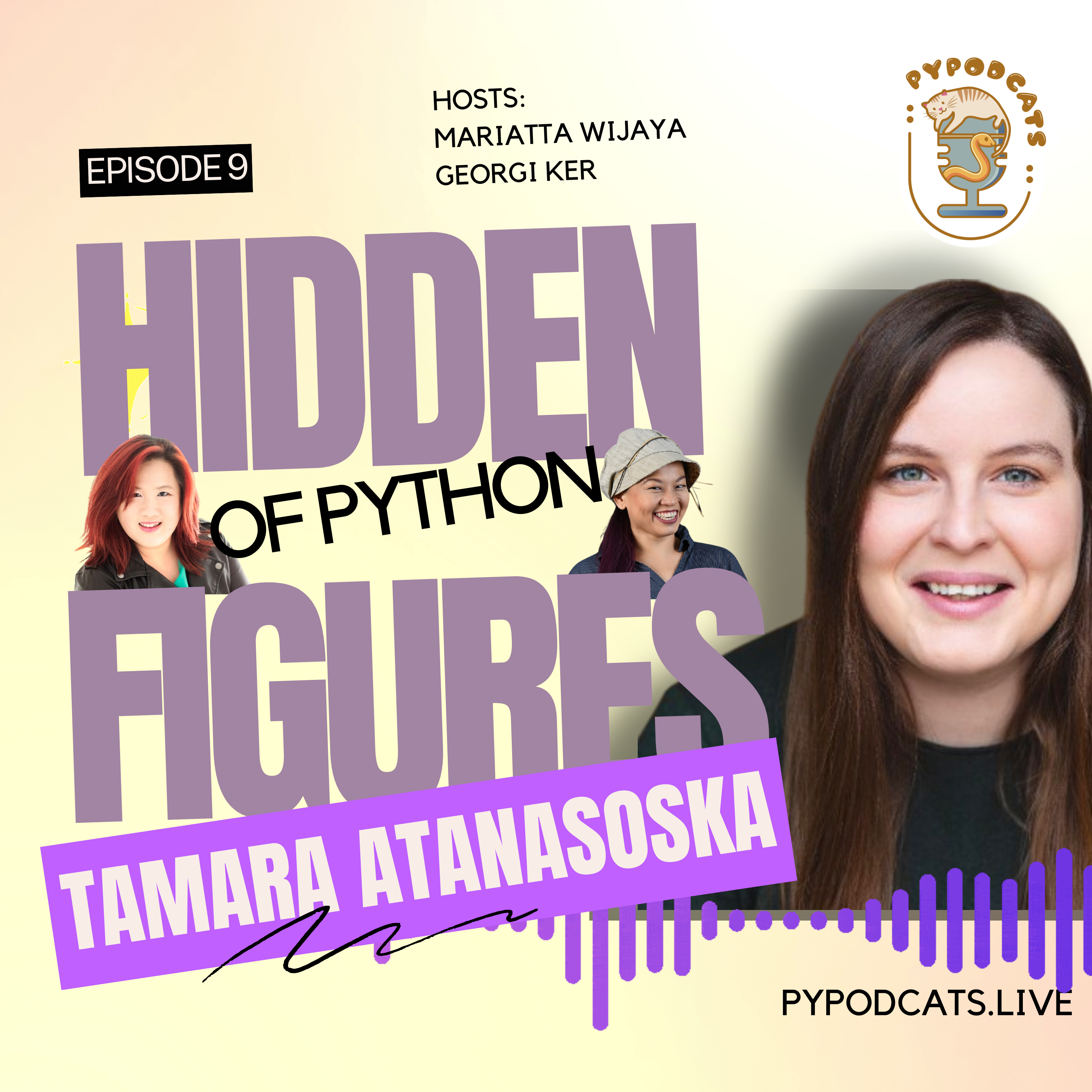
00:20
Hi everyone.
00:21
Welcome to PyPodcats, the Hidden
00:24
Figures of Python podcast series.
00:26
The PyPodcats is, a podcast
00:29
highlighting voices from
00:30
the underrepresented group
00:32
members of the Python community.
00:34
So we do have a Code of Conduct
00:36
that is following
00:37
the PSF Code of Conduct.
00:39
And if you're interested
00:40
to know more, you can always,
00:42
check out our website.
00:44
Very excited to be back because
00:46
this is 2025, probably the first
00:50
guest for our 2025 podcast.
00:53
My name is Georgi and I'm one
00:55
of the PyPodcats hosts
00:57
and I'm based in Amsterdam.
01:00
Also one of the PSF Director
01:03
of the Board.
01:05
And to you, Mariatta.
01:06
Hi everybody.
01:07
I'm excited that we are
01:09
resuming the PyPodcast series.
01:12
My name is Mariatta, I'm based
01:14
in Vancouver, Canada and I'm
01:16
in the Python community.
01:18
I've been contributing for many
01:19
years as open source contributor.
01:23
I'm also one of the Python core
01:24
developers and, and I'm also
01:26
involved in the PyLadies community.
01:28
Our guest today is Tamara.
01:30
Tamara, can you introduce yourself?
01:33
Hi.
01:33
Thank you so much for having me.
01:34
I'm also really excited
01:36
to be the first guest for 2025.
01:40
So I'm Tamara.
01:41
I, am currently an Open
01:44
Source Software Engineer.
01:46
That's my title
01:46
at a company called Probabl.
01:48
Probabl is the brand ambassador
01:50
for scikit-learn.
01:52
And my job there is I work
01:55
in the open source team
01:55
so I'm sponsored to work
01:57
on open source packages.
01:58
One of my jobs, includes
02:01
maintaining Fairlearn that I
02:02
hope we're going to talk about
02:04
a bit more later about.
02:05
And I do contribute to scikit-learn
02:07
and I've contributed to another
02:09
package recently called Spops.
02:11
At the same time, some of my time
02:13
in the week goes to research.
02:15
That's going to become
02:16
my master thesis.
02:19
I am part of a program that's mainly
02:21
about computational linguistics,
02:23
but also has some cognitive science.
02:24
Yes, that's me at the moment.
02:26
I've also been involved,
02:27
I guess in the Python community
02:28
for over a decade.
02:30
So there's a lot different.
02:33
Yes, since 2012 it's been a bit.
02:38
Wow, it's been a while.
02:41
Yeah.
02:42
That's crazy.
02:44
So, yeah, you were just
02:46
talking about Fairlearn.
02:48
So what is Fairlearn about?
02:49
It sounds like a game for me.
02:52
With the name
02:54
Learning Fair.
02:55
Yeah.
02:56
So Fairlearn is a, I guess the best
02:59
way to describe it is a toolkit
03:00
is a library that it provides tools
03:02
for data scientists to work on.
03:06
Increase the AI safety
03:07
of their applications.
03:10
So I think if we don't go too
03:13
deep we can think of FairLearn
03:16
as a library that provides
03:18
metrics and also provides a
03:21
specific kind of methods for
03:24
assessment and mitigation of
03:26
unfairness in this case.
03:28
But it is based on a specific type of
03:30
fairness, which is group fairness.
03:32
And what does that mean?
03:34
I think it's important to address
03:36
is that we have tools for people to
03:38
evaluate how a model would perform
03:41
for different groups of people.
03:44
And in Fairlearn we call this
03:46
groups of people sensitive
03:47
features but they can be any kind
03:49
of subgroup that you want
03:50
to make sure the algorithm or
03:52
the model performs fair for.
03:53
We can think of any
03:54
examples like sex or race or any,
03:57
any really combination
03:58
of the subgroups as well.
04:00
This is based on something called
04:02
disaggregated evaluation.
04:04
And these are the metrics
04:05
and the other methods help with.
04:07
Do you have any like case
04:09
study of a company
04:11
or a project that uses Fairlearn?
04:13
I love this question because
04:15
it's a, it's an interesting
04:16
problem that we have.
04:17
We do really love working
04:19
on this and it's part of my
04:23
the research does, I read
04:24
papers around this method.
04:26
But one of the core problems is
04:29
that a lot of the people who do use
04:30
the library and there are plenty
04:32
because I think in December
04:34
there were half a million downloads.
04:37
Whoa, is that.
04:39
Yes, it's big and it's
04:41
interesting that it's really hard
04:42
to get any data about it.
04:44
And this is as somebody that's
04:47
just getting in this area
04:48
from an academic standpoint,
04:50
I wasn't in it before.
04:52
I learned from the senior
04:53
researchers that a lot of the
04:54
companies do not really want to
04:56
discuss the usage of these kinds
04:58
of tools and would definitely
05:00
not make any of their data sets
05:02
available.
05:03
But if you go on the website
05:05
I think this is one of the biggest.
05:07
Despite the excellent metrics
05:09
and really careful editorial,
05:11
decisions that are made and we
05:13
really do not add anything that
05:15
hasn't been mindfully vetted.
05:16
In a sense one of the biggest things
05:18
that we focus on is education.
05:20
So if you, if somebody opens the
05:21
website there is a place with
05:23
example notebooks and there in the
05:25
example notebooks there is one
05:28
white paper that was made by
05:30
Microsoft who started the library
05:32
many years ago.
05:33
But now it's community led.
05:34
Ernst and Young, if I pronounce
05:36
that right, that worked on
05:38
credit fairness in the states
05:41
between male and female applicants.
05:44
And it's a really interesting
05:45
case study to read of course,
05:48
one can assume there are
05:49
constantly this kind of scandals
05:51
coming out in the open.
05:53
You could assume that somebody
05:54
uses something somewhere.
05:56
Sometimes people from governments or
05:58
from different institutions come
05:59
to our community calls which are
06:00
by the way open for everyone.
06:02
They happen every second week
06:04
at 6pm Berlin time.
06:05
I don't know what is that
06:07
in other time zones?
06:09
Easily.
06:10
People can easily find it
06:11
on the website.
06:12
The time zone problem.
06:14
Yeah, most of the people that
06:16
contribute are coming from the U.S.
06:18
so they, they always say their
06:19
time and I always forget because I'm
06:21
in Europe, in Berlin.
06:24
Yes.
06:24
So this is a very
06:25
interesting question.
06:25
And if anybody's listening
06:27
to this that's using
06:28
Fairlearn, we have a survey,
06:31
that we just recently made.
06:33
One of our maintainers, Michael
06:36
created it for this specific purpose
06:38
because we are a bit in the dark.
06:40
We would like to serve the community
06:41
better, but we would
06:43
need the community to,
06:44
to be brave to talk to us about
06:46
how they use the tools.
06:49
Yeah, okay.
06:50
Yeah.
06:50
Share the link with us.
06:52
Maybe, we'll share it when
06:54
would be amazing.
06:55
Yeah, yeah.
06:56
So people who use Fairlearn
06:58
share how you actually use it.
07:00
Yeah, I find it, it's interesting.
07:03
Do you think people hesitant
07:05
to share like they don't want, they
07:07
don't want to tell that they are
07:09
using Fairlearn or what is,
07:11
is there a reason they are not?
07:12
I think a lot of the models
07:16
will have maybe non ideal results.
07:19
Now this is another
07:20
interesting question.
07:21
So one thing is to assess unfairness.
07:24
You would start for example
07:25
with defining your sensitive
07:27
groups and understanding what
07:29
your specific use case is.
07:30
It always has to be specific.
07:31
And then you would pick the right
07:33
metric that different metrics
07:34
like demographic parity
07:35
of equal odds, you can assume what
07:37
they mean maybe by the name
07:39
where we can discuss them.
07:40
But after that you can use some of
07:42
these to assess how the model works.
07:44
In case of demographic parity,
07:46
for example, is this you know, equal
07:47
for the demographics involved?
07:49
But the mitigation itself,
07:52
it's a, we do provide some tools
07:55
for mitigation in the library.
07:57
And there are many, many
07:58
other ways to do mitigation.
08:00
But mitigation, it's really not easy.
08:02
It's a very case to case, basis
08:05
and the answer might be in your
08:07
data, in adjusting your predictions,
08:09
in balancing some other ways.
08:11
There are other ways
08:12
of mitigating with intermediate
08:15
representations and so on.
08:16
It can get pretty complicated.
08:17
But only you can do this
08:19
in your own use.
08:20
And it's not easy to do after
08:22
you've set up everything to redo.
08:24
Because fairness has to be
08:26
from the very beginning considered.
08:28
When you create a product
08:30
or a model, it has to.
08:31
The idea of it being fair has
08:34
to be woven into the whole process.
08:35
And I think a lot of people maybe,
08:37
yes, they assess at the end and then
08:40
I don't know what they do.
08:41
Right.
08:41
What if like halfway through
08:43
they say, oh, actually
08:45
I forgot something that we
08:47
should actually add on to it.
08:49
What did they do?
08:51
I don't know.
08:51
I would like to know what people do.
08:55
I, I recently became a, part
08:57
of a very, very big Slack
08:59
channel and I was asking people,
09:00
hi, how do you use fairness?
09:02
Please tell me something.
09:03
Nobody told me anything still,
09:05
but maybe somebody will.
09:07
Okay, yeah, hopefully we get to
09:10
share your survey and so hopefully
09:11
you get responses and you get
09:14
to learn more about the user.
09:16
I do believe there are some maybe
09:17
like big companies have idea
09:19
about this in their own internal
09:21
teams and senior researchers.
09:22
But you cannot say
09:23
anything about this.
09:25
Yeah.
09:26
So let's bring it all the way
09:30
to the beginning.
09:31
Like we are here talking
09:33
about the Python community.
09:34
So I'm actually kind
09:35
of interested to know how you
09:37
actually started using Python.
09:39
Yeah.
09:39
So Python wasn't the first
09:42
language that I work with.
09:45
I started during my studies
09:48
in the late 2000s.
09:49
They didn't really teach
09:50
Python at universities.
09:51
We studied C and C++ I believe.
09:55
And then I did my first Google Summer
09:58
of Code contributing gnome.
09:59
It was in C>K if I
10:02
remember it was 2011.
10:05
And then I was also
10:07
very politically active at the time.
10:10
And I went, I was, it was time
10:12
for the second GSoC.
10:14
And then I was okay, I want to do
10:16
something that's really specific
10:18
about citizen participation and
10:21
works really, really directly
10:23
addresses, not indirectly as any
10:25
open source would, but directly
10:27
addresses a political issue.
10:29
And I found a small project
10:31
from Spain called e-cidadania.
10:34
I don't know if you pronounce
10:35
that right now, I am
10:37
in Spanish, but it was a citizen
10:41
participation platform.
10:42
Exactly.
10:43
And it was in the time it used
10:45
Django and JavaScript to create this
10:49
little kanban like discussion,
10:52
if I can describe it now.
10:54
And it was supposed to be used by
10:55
the local government, if I remember
10:57
right, to increase the participation
11:00
of the local people who live there.
11:03
And we worked on that.
11:05
It was really fun.
11:07
And then I think I just never
11:09
stopped working with Python
11:11
because I learned Django
11:12
and I felt so empowered.
11:13
I was, I can do anything now.
11:18
Yeah, because Django was, wow,
11:21
these kind of frameworks
11:22
in 2012, 2013, I was like, I can
11:24
build any website I want.
11:27
And then I, then I also had
11:29
a job and a think tank.
11:31
I worked at a think tank
11:32
as a software engineer.
11:33
I had a little team and we did
11:35
projects that were meant for,
11:38
to increase either awareness
11:40
or address social issues.
11:41
It was really still my favorite
11:43
job so many years after.
11:45
And this is.
11:46
I could directly just use my
11:47
skills there and I felt just.
11:50
Yes.
11:51
And I still do Python.
11:52
That's very cool and I love that.
11:54
I think we need to
11:56
highlight that quote.
11:57
Just now like, with Django,
11:59
you feel so empowered.
12:03
I remember thinking
12:04
I can, I wanted to.
12:06
I can do everything now.
12:08
I know I, I'm a big fan
12:11
of the Django web framework myself.
12:13
That's what I also use
12:14
professionally.
12:15
So.
12:15
And I totally agree.
12:17
Like, I mean right now I'm like
12:21
I'm trying to replace all
12:23
my spreadsheets with Django.
12:27
I'm trying.
12:28
But yes, I love it at the end.
12:30
It will be easier to edit eventually.
12:32
Yeah, yeah, I think.
12:34
Yeah, yeah.
12:35
So you know, It's Django
12:39
in 2012 that was.
12:41
I think it was like Django one point
12:43
something probably, or Django two.
12:46
I don't know that it's
12:47
a long time ago.
12:48
I wonder if you had encountered any
12:51
difficulties or other
12:53
limitations when working with
12:55
Django and Python back then.
12:57
So I think, people can.
12:59
It's archived now on GitHub, our
13:01
repository from then, but they can
13:03
go and still see the type of commits
13:04
and PRs that we did in the past.
13:07
They're not what I would do now.
13:08
But I am not embarrassed
13:10
from my beginnings.
13:11
They can check out how
13:12
we did Django then.
13:15
Yes, there were plenty of, growing
13:17
pains as somebody that only did
13:20
C and C++ and thought in a very
13:22
different way about programming.
13:24
And I never did web before
13:25
in the, in the time.
13:26
And it was all I had to start doing
13:29
to apply for the GSoC.
13:32
I really, really wanted it.
13:34
And I was part of a hacker space
13:36
for those few years already.
13:39
And it's lovely because when
13:41
you're part of a hacker space
13:43
you have so many people
13:44
that are just there to hang out
13:46
and hack and code and mentor.
13:49
And there was a person called
13:51
Vladan, which is shout out
13:52
to Vladan if he ever hears this.
13:55
And I remember that he was a great
13:58
help to just push me to learn
14:00
and get this through this.
14:02
Growing pains faster.
14:03
Yeah, I think there was a lot
14:05
in the, in the time that
14:07
it wasn't just learning Django,
14:09
which maybe I don't know.
14:11
I think a big part of learning Django
14:12
is learning how the web works.
14:14
When you're beginning with Django,
14:16
I think, I knew theoretically
14:19
from my studies because we
14:20
did networking and so on.
14:21
I have a Computer Science
14:22
degree that I did before that.
14:24
By the time I had it finished
14:25
by 2012, I was trying
14:27
to, I started the masters.
14:30
But yeah, I think, I think it
14:33
was just so lovely and it was very
14:35
different from my C>K
14:38
experience the year before that.
14:40
It was no going back,
14:42
but it wasn't, it wasn't fully
14:44
straightforward, that's for sure.
14:45
It's just, it's hard for me
14:46
to remember was 13 years ago.
14:51
I remember somewhere, somehow
14:55
in one of my high school or
14:58
polytechnic days we have basic
15:01
Computer Science and I learned C
15:04
there and I un-seen it.
15:06
Now I C and un-C.
15:15
Yeah, it was a lot.
15:17
C.
15:17
was a lot.
15:17
I think people still do it
15:19
now, I guess, but they are.
15:20
They do, they do, they do.
15:22
It's CPython.
15:23
Exactly.
15:25
Yes.
15:26
When we built Python,
15:28
it's still used.
15:30
But yeah, I also, I, I use Java and C#
15:34
before I learned Python,
15:36
but once I use Python, yeah, I'm.
15:38
This is the language I feel like
15:41
makes sense to me, you know, it's.
15:43
Also, it's so versatile.
15:45
So in back then I did web and then
15:47
I did web for a few years and
15:49
then in 2015 I got a job where I
15:53
used Python to write hardware
15:54
bindings, which was for music
15:56
instrument.
15:57
It was really fun.
15:59
And then I, then I transitioned
16:02
to doing machine learning and NLP,
16:04
which one my degree is in.
16:06
So Python is very versatile.
16:08
It is, it's not just
16:10
Django that's empowering.
16:11
It's like you have a language
16:13
that will take you through all
16:14
of this that you can
16:16
lean back as a basis on.
16:18
I love that.
16:19
Can you talk more about your
16:21
involvement in the Python community?
16:23
Like how or.
16:25
I know you said you started using
16:27
Django and Python, but that's using
16:30
the language but then you become
16:32
involved in the community.
16:33
Can you talk more about that?
16:35
Yes.
16:36
So, I guess by getting involved
16:39
in Python as a community slightly
16:41
related to my immigration because
16:43
I come from a country
16:45
that's now called North Macedonia.
16:47
Wasn't called like this
16:48
where I lived there.
16:50
But so in there wasn't any
16:53
separate Python community,
16:55
although I already contributed
16:56
open source-wise to Python.
16:58
It was we were all one
17:03
technical community so to say.
17:05
And since I was mostly I was tightly
17:08
intertwined with a Gno,me community
17:10
before went to their conferences.
17:13
I was involved in the pre-
17:15
Outreachy kind of groups.
17:18
And so on.
17:21
I did program in Python
17:23
but I never saw the community
17:24
as a separate thing.
17:25
And when I immigrated or was trying
17:28
to immigrate to Berlin in 2013,
17:30
I get to know the PyLadies.
17:32
The PyLadies.
17:33
This is one of the people,
17:35
the first people that showed their
17:37
welcome for me in the city.
17:39
So it's still my longest
17:41
standing relationship and I
17:42
really appreciate it.
17:44
I don't think I would have
17:45
moved if they did not
17:46
were so welcoming to me.
17:48
There's Meili.
17:49
I don't know if she's ever gonna
17:51
hear this but she's still my friend
17:52
and somehow I met her and she
17:55
invited me to give a talk about
17:58
all this political projects.
18:01
I did politically related projects
18:03
that were connected
18:04
to raising awareness or.
18:05
And they were all in Python
18:07
at the time.
18:08
As I said, empowered
18:09
to do everything.
18:10
And I remember doing that talk.
18:12
I don't remember anymore.
18:13
I cannot find any of the slides.
18:15
But I went.
18:16
I had to go back to where I was
18:19
from because you cannot apply
18:20
for a visa from Germany.
18:22
And I had to figure all of that out.
18:24
And when I came back the community
18:27
was there and that was really great.
18:28
And some of those people that I've
18:30
met there are still some of my
18:32
closest friends where I'm here.
18:34
So Yeah.
18:38
I have never been truly organizing
18:40
in the community
18:41
but I've given several talks.
18:45
My most recent one was in January.
18:48
I always go back when I have
18:49
something new and what I really want
18:51
to share with with the community.
18:54
And I, I mentor in sprints.
18:57
I've mentored Django girls
18:59
and similar kind of events.
19:02
Wherever there is help
19:03
needed of the sort.
19:05
Yes.
19:05
So I guess in that way I do.
19:08
Except well separate from
19:10
my open source work I did.
19:12
It's.
19:12
It's.
19:13
It's worth mentioning that during
19:14
the pandemic and when my, When I was
19:18
a very new mom, that was more rare.
19:21
I think I do a bit more now
19:22
than I did in those years.
19:25
Wow.
19:25
But that.
19:26
That sounds a lot like you
19:29
are still pretty involved.
19:30
I mean right from the beginning till.
19:33
Till what you are at right now
19:35
and like getting involved
19:38
in code, on the contribution,
19:40
that's quite a bit of time there.
19:42
And plus the community,
19:44
plus getting, sharing your.
19:47
Your knowledge to the community
19:49
by giving talks and then
19:52
finally adding it to like providing
19:55
giving mentorship which is like wow.
19:58
From zero to all the, all
20:00
the level, from beginners all
20:02
the way to the expert
20:04
levels, you cover everything.
20:06
So thank you.
20:08
Yeah, I mean it's, it's really
20:10
amazing to see someone like you who
20:13
are so, so passionate about sharing
20:17
what you know to the community.
20:19
And I think because of people like
20:21
you, we get to learn more and we
20:24
get to understand a lot, a lot
20:25
more about how we can use the
20:29
different cases and how we can
20:31
actually learn literally when you
20:33
mentor people.
20:35
So I'm actually very, very
20:37
interested to know like
20:39
how do you work on mentorship?
20:42
Because I recently had
20:44
very interesting conversation with
20:47
Djangonauts Space people and we are
20:50
talking about how we could actually
20:53
improve on mentorship.
20:56
So I would like to hear from
20:57
your point of view, like,
20:58
how do you actually started
21:00
like mentoring people
21:01
and to get people to understand or
21:03
to get people to learn?
21:05
Because people, when they
21:06
learn they come from all sorts
21:08
of all walks of life.
21:09
I think I have to mention something.
21:12
For me, mentorship is part
21:14
of my core values and it's related
21:19
to justice for me.
21:22
I come from a working class family
21:24
that didn't have a lot of resources
21:26
and it was really hard
21:27
for me to stay and get access
21:29
to more education programs.
21:32
Like the way my hackerspace friends
21:34
helped me with those Google Summer
21:35
of Code projects, made me pay off my
21:39
student loans that I had and I
21:41
wouldn't be here without them.
21:43
And the effort I do for me is just
21:48
a way to keep this going,
21:49
taking people with me on the journey
21:52
and it's never going to stop.
21:53
It's just part of my ethos,
21:55
in a sense.
21:56
So every time I show up, I show
21:58
up with this in mind.
21:59
So every time I get an idea
22:00
to talk at the PyLadies, it's.
22:02
I learned, I think in my last talk
22:04
I said that my company also does
22:08
certification for Scikit Learn, so
22:10
maybe people should check it out.
22:12
It's, they're really doing
22:13
a great job with it.
22:14
And there was an expert topic they
22:17
they mentioned and I was like, okay,
22:18
they mention it as an expert topic
22:20
as part of the expert certification.
22:22
I'm making a talk immediately
22:23
to bring it to the PyLadies because
22:25
I want these people to live the room
22:27
feeling as experts in that night.
22:30
So this is what guides me.
22:32
What got me into this was this,
22:33
of course, this experience with
22:35
the hackerspace which predates this
22:38
immigration experience and all
22:39
the more deep Python involvement.
22:42
And also I gained some skill by being
22:45
a TA at the university. My first
22:48
degree, that was a really long time.
22:50
I think their skills were refined.
22:52
I have a very different
22:54
approach now than I had when I was
22:56
a child at university,
22:57
so to say, a young person.
22:59
Yeah.
23:00
And for the, how do
23:01
we, how do we mentor.
23:02
I think there as open source in
23:05
open source contribution sprints or
23:07
for people to get involved.
23:08
There is a specific, I do have very
23:11
specific ideas there that I'm
23:13
trying now as a first, I'm a, I've
23:14
been involved for so long, but I've
23:16
never been a maintainer and I've
23:18
even had keynotes to talk to other
23:20
people.
23:20
I never had the chance
23:21
to any, to implement anything
23:23
of what I've been saying.
23:24
I could only hope that other
23:25
people would implement it.
23:27
And now I'm trying to pour into
23:30
the project as much as I can and it
23:34
shows in the way we do our sprints
23:36
and the way we try to retain people.
23:38
Some things for me that
23:40
are really, really important are
23:42
structure and process and a focus
23:45
on continuous involvement.
23:48
And I'm really trying to work
23:50
on these aspects at the moment.
23:52
So not just getting people in, we
23:54
can do a sprint, but we want people
23:56
to stay and work with us.
23:57
We want them to feel nice and welcome
24:00
and necessary and useful and to
24:05
take this knowledge out as well
24:07
out in their other projects.
24:09
Could you share some examples of
24:12
how you plan to implement this?
24:14
Like I know you mentioned you have
24:15
some ideas and you felt like
24:18
because you weren't a maintainer
24:20
you couldn't implement this.
24:22
And that's an interesting topic.
24:25
Maybe I'll ask about it
24:26
a little bit later.
24:27
But now you have these ideas.
24:29
Can you share a little bit,
24:31
a snippet of what it is?
24:33
Yeah, I think for different projects
24:35
it will mean a different thing.
24:36
So for example, things that
24:38
I've worked on recently
24:40
that turned out to be great.
24:42
I just.
24:43
When was it?
24:44
It was three weeks ago.
24:45
Two weeks ago we had a sprint.
24:48
And I.
24:48
That's very recent.
24:50
but it wasn't
24:54
the only sprint recently.
24:55
So I spent two weeks before
24:58
the sprint digging up,
24:59
first issues that were.
25:01
There was a gradation there
25:02
but they were all separate,
25:04
not part of a giant one.
25:05
They didn't involve so much thinking,
25:07
but they were perfect for teaching
25:08
the process and making closing.
25:12
So making a PR that can be
25:14
also merged really quickly.
25:15
So everybody that participated in
25:17
the sprint made a PR by the end of
25:19
it and everybody was really happy.
25:21
So we don't know how many of these
25:22
people are going to stay but for
25:24
example, in our Discord channel, I
25:27
constantly post whenever there is
25:28
a new issue, how difficult it is.
25:32
I offer help for people to continue.
25:36
And we had, for example
25:37
from the PyLadiesCon,
25:38
we had a person that joined.
25:40
I was just me online, there not.
25:44
It was not in person.
25:44
Right.
25:45
It was an online conference and we
25:46
had a person that did heard about
25:49
the project, but didn't really have
25:51
time to participate and now is still
25:53
one of our most active contributors.
25:56
Yes, shout out to Neha.
25:58
Yes, she's lovely.
25:59
And for example, right now she
26:03
is interested in helping with
26:04
some of the project management
26:05
efforts that we're doing.
26:07
And it's really cool.
26:09
We have an issue together at a link.
26:12
She has been a collaborator
26:13
to redo all the documentation
26:16
for newcomers as well.
26:18
The perspective of people
26:19
new to projects,
26:20
is really, really valuable.
26:22
And right now I think
26:24
this is the biggest project
26:25
that I want to do.
26:26
We seem to be attracting
26:28
and people are really happy
26:29
at the sprints, but there is a bit
26:31
of a structure and process
26:32
lacking for them staying.
26:35
And although we have a lot
26:37
of downloads, as I mentioned,
26:39
the project is really small.
26:41
There are not a lot of maintainers,
26:43
that are very active or just.
26:45
It's just a small project.
26:46
It's okay as it is for just
26:48
the maintenance, but for growing or
26:50
for including people, we need to do
26:53
a little bit more and we want to.
26:55
So right now I'm having an initiative
26:57
to organize things in
27:00
little groups so people, when they
27:01
come into the project can be
27:03
interested in a specific group.
27:05
So to say it doesn't have.
27:07
They mean they can also build
27:08
expertise and be an expert person
27:10
in the documentation.
27:11
That is awesome.
27:12
But it needs to be presented
27:13
in a way that it shows a path.
27:15
We don't have that right now.
27:16
I think a lot of big projects
27:18
definitely have this.
27:20
That's why I say it's dependent
27:21
on the project or things like, other
27:23
types of improvements because it's.
27:25
People come to a project like,
27:26
okay, I'm going to contribute,
27:28
let's do this, a little bit of that.
27:29
But a big Python code base
27:32
doesn't have just one type of thing.
27:35
I've been.
27:35
Most of the things I've been
27:37
contributing for this last month
27:39
have been Scikit Learn, cross
27:40
compatibility because I also
27:42
work with Scikit Learn and
27:43
improving Fairlearn to be
27:45
seamlessly used in the Scikit
27:47
Learn pipelines and so on.
27:49
And this is just one type of thing.
27:51
You don't have to be an expert
27:52
in anything and I want to make this
27:54
explicit by, by categorizing thing
27:57
so people can find their own niche
27:59
and feel confident in it.
28:01
So not just oh the for example
28:03
the FairLearns methods are really
28:06
quite a bit of advanced knowledge
28:08
in maths or statistics and this
28:11
can be very intimidating.
28:12
Somebody joined the PyLadiesCon
28:14
and told me that they felt
28:16
more intimidating contributing
28:18
to the Fairlearn compares than
28:19
the Python core which then
28:21
I felt okay, we need to, yes.
28:23
Fix this.
28:26
I think some of our
28:27
methods look very cryptic.
28:28
We need.
28:29
And we are definitely
28:30
working on fixing it.
28:33
So this is one of the efforts.
28:35
Yeah, so that's what I mean.
28:35
You don't need
28:36
to understand this math.
28:37
There's so many other places
28:38
you could be essential.
28:40
There's just so much
28:41
work always to be done.
28:42
But it's not explicit and we're
28:44
not showing people gradation
28:45
how they build the skills.
28:47
There's also a lot of, volunteer
28:49
time is precious and you
28:53
know maintainers need to support
28:55
like as a maintener,
28:56
Easy for me to get lost
28:57
in my little technical hole so
28:59
to say digging endlessly.
29:01
But I think I'm more useful.
29:03
unblocking others
29:04
and supporting the project to stay.
29:06
So this is my, I'm doing the more
29:08
grunty work myself because I want
29:10
others to you know do this kinds
29:12
of things for our project.
29:13
This, we don't have any
29:14
of this but I, I've been involved
29:16
in projects like Gnome
29:17
which are my inspiration.
29:19
I have to say I don't know
29:19
how it is right now.
29:21
I have not been contributing
29:23
for such a long time and they
29:25
had such strong organization
29:27
where you could feel that
29:29
every contribution is really valued.
29:33
Every type of contribution.
29:34
That's something
29:35
that we have lacking a
29:37
little bit still the code,
29:40
a few appreciators.
29:41
Yeah.
29:42
But also every type, not just
29:43
the programming and specific type
29:45
of programming being celebrated.
29:47
Yeah.
29:48
Because everything
29:48
is really valuable.
29:50
It's true, it's true.
29:51
Yeah.
29:52
I feel like the fact that
29:54
you phrase it that way.
29:55
I do feel that there is
29:57
this, how do I say it?
29:59
Like appearance like that
30:02
code contribution is
30:04
being celebrated more compared to
30:07
other kind of contribution.
30:09
Like it's hard to.
30:11
Yeah.
30:11
I don't know how to address that
30:13
I mean every contribution counts
30:16
because yeah Open source
30:18
doesn't mean it's zero effort.
30:22
Anything that anyone volunteers
30:24
to do something, it matters.
30:27
Absolutely.
30:28
But I don't think that people feel
30:29
this sometimes in the projects where
30:31
they work as somebody that has been
30:33
mostly contributing code to project
30:35
and wanted to do other things.
30:37
I could see the stark difference when
30:39
I would be in the different types
30:40
of contributing and also when I did, for
30:42
example, I did several jobs where
30:43
I had developer relations jobs.
30:45
And you could feel also
30:46
the difference there, how you're
30:49
perceived and how your
30:50
contributions are perceived.
30:52
I think this is a mindset, but it has
30:55
to come from the maintainers.
30:56
This true.
30:57
There's also a very common
31:00
discussion point that we talk
31:02
about is that a lot of people,
31:06
when they start sprints, it's
31:08
really hard, like to prepare for
31:12
the new contributors because
31:16
sometimes a lot of maintainers,
31:18
like you said, you're already
31:20
really deep into your project.
31:23
So your mindset is.
31:25
I already know that.
31:27
So some of the people who are new,
31:29
they get to like confused like
31:32
even the very basic on how to start
31:34
and how to get things going.
31:37
So like say, for example,
31:38
if there's one person coming
31:40
to join, it's easy.
31:41
What if like there's 10?
31:43
How do you prepare to get so
31:45
many different people to start?
31:48
So I wonder if you have a specific
31:52
idea how you manage that.
31:55
So for this particular sprint, I had
31:56
10 people and I was from my project.
32:02
I do had some help
32:03
from the second, people.
32:07
It was lovely.
32:08
I honestly, I think there's nothing
32:09
that fulfills me more than a group
32:11
of people, getting to know
32:13
and starting and seeing them glow by
32:15
the end because they've made a PR.
32:17
I.
32:18
That's.
32:18
It's just the most
32:19
fulfilling thing ever.
32:20
So I, So how we prepared.
32:22
There is an issue in Fairlearn, if
32:25
anybody's interested, that I started
32:26
to prepare for the sprint.
32:28
I did it with Neha.
32:29
Neha is great.
32:30
Thank you, Neha very much.
32:32
My main collaborator on the issue.
32:34
We did several points.
32:35
One of them we still
32:36
haven't fulfilled.
32:37
And for example, we went through
32:39
all the documentation and Neha had
32:42
ideas and rewrote some of it.
32:44
For example, we didn't have a step
32:46
explaining how to do a virtual
32:48
environment because this is just.
32:49
I.
32:49
Sometimes I just don't
32:51
think about it.
32:52
But it's.
32:52
Yeah, it's something
32:53
that we should do.
32:54
So we added these kinds of things.
32:56
We redid some language, added
32:57
some more links, added Code
32:59
of Conduct everywhere because we
33:01
didn't have it in enough places.
33:02
We redid the readme so it's
33:04
more easier for people to
33:06
just jump on different places.
33:09
What else?
33:09
There's more things that we did,
33:12
I don't remember.
33:13
The only thing we didn't
33:14
do was Create videos for
33:15
people to watch at home.
33:17
That is coming next.
33:18
I have a person that volunteered
33:19
to do it for Windows.
33:20
I don't have a Windows machine
33:22
and I will do it for MacOS.
33:24
And I.
33:24
And the main thing I did myself was
33:27
digging out just the right
33:28
type of issues because I did
33:30
study a bit of cognitive science
33:31
and early childhood development
33:33
and language and so on.
33:35
And one of the interests, biggest
33:38
interests that I have is learning
33:39
and learning itself for the brain.
33:42
And one of the biggest problems
33:45
with language learning for example
33:47
is the gap from B1 level
33:50
to like getting the next levels.
33:52
And this is because
33:54
the gradation of tasks disappears.
33:56
For somebody to be challenged
33:57
but not overwhelmed and quit.
33:59
You need the right type of task.
34:00
It needs to be not too hard
34:01
and not too easy.
34:03
And this is how you
34:05
go to the next level.
34:06
And this is the same type of thinking
34:08
has to be applied to an issue.
34:09
For a Sprint, for example, if it's
34:11
the documentation works,
34:13
they're not big hiccups.
34:14
There's the issue itself is teaching
34:17
you the flow does not require
34:19
an immense amount of digging.
34:22
It's just loud.
34:22
There are so many people.
34:23
So somebody can do this semi
34:25
independently after you have
34:27
unblocked them in some way.
34:28
That is a really good,
34:29
good first issue.
34:30
There could be a follow
34:31
up but the first issue
34:32
should be really easy.
34:34
It is a very hard thing
34:35
for projects too.
34:36
I hit them for good first issues.
34:38
Labels.
34:39
I put them under reserved
34:40
for Sprint for two weeks.
34:42
So they were not available
34:43
for the general public.
34:44
This is.
34:45
Yes, that will happen
34:47
every single time.
34:48
But yeah, we had some, some
34:49
for the, for the public.
34:50
I see that you're contributing
34:52
everywhere and things like that.
34:54
Like other than that, aside from
34:57
code and community, do you do any
35:01
other things like do you
35:03
have any personal interest or.
35:05
Yes, I guess I spend most
35:08
of my times when I'm not working or
35:11
doing work related things or
35:12
community things with my son.
35:14
I have a child, he's
35:16
gonna be seven soon.
35:18
Well very soon.
35:19
It's probably my favorite part
35:20
of the day most of the time.
35:22
Yes.
35:24
I also have a little blog or
35:27
a substack, however they call this
35:28
thing newsletter these days.
35:30
I moved my blog there and I
35:32
write about language, technology
35:34
and society which
35:37
are my main interests.
35:38
I don't write very often but if
35:40
people want to hear me talk about
35:41
these things they could subscribe.
35:45
Yes, I love to read and I love
35:48
literature and everything.
35:50
Literature again ties to my love
35:51
for language I have to say.
35:53
And I do take care
35:54
of a lot of plants.
35:55
Cool.
35:55
At the moment that's like a lot of
35:58
things that you, you're organizing.
36:01
Right?
36:02
Those are the recharging things.
36:04
Those my, my child and my books
36:07
and my thoughts about
36:10
language and, and society are
36:13
just, it's where I, I, I draw energy
36:15
from and sprints as I said.
36:17
I don't know.
36:19
That sounds like de-charging for me.
36:24
It's recharging for you.
36:26
So.
36:31
So with so many things that you have
36:34
in your mind, what is your plan like
36:37
you, that you want to work next?
36:39
Because it seems like you have some,
36:41
quite a lot of things going on like
36:44
the plans that you have in future.
36:46
I think in thinking about it
36:49
a lot personally as well.
36:51
I've spent the last 15 years
36:53
really guided by curiosity
36:56
and a giant desire for technical
36:59
newness and depth and just
37:02
creativity of that kind.
37:04
And these days, especially this
37:05
year, I realized that more and more
37:09
I get fulfilled by unblocking
37:12
others and growing others and
37:13
helping fostering environments
37:15
where things can involve as many
37:18
people as possible.
37:19
So I think in the next few years I
37:21
want to think and implement
37:22
initiatives in the projects I'm
37:24
involved in or as my day to day
37:26
job where I can uplift others and
37:29
empower and support and unblock
37:31
people.
37:31
I think that is, that's my
37:34
main focus at the moment,
37:35
or I would like it to be.
37:37
I'm still a software engineer
37:39
mostly at the time.
37:41
Still the idea of giving back, giving
37:44
back, like what you learn, you're
37:46
just, it just sounds so generous.
37:48
Like whatever you learn, you
37:49
just want to share and let
37:51
everyone know what you learn.
37:52
I mean I've been loved and helped.
37:54
Right.
37:54
It's only just to
37:56
continuously give back.
37:58
Wow.
37:59
We need 200 Tamaras out
38:02
there and the community
38:03
thrives immediately.
38:06
I think when I look at my friend,
38:08
Jessica Greene for example,
38:09
you must know Jessica Greene.
38:12
There is one at least that I
38:14
know that my friend Meili and all
38:16
of these other people
38:17
that I'm in touch, they're just
38:18
really, really generous.
38:19
They've been generous with me
38:20
and I want to be generous with
38:22
the world too as, as much as I can.
38:24
You know, we have seasons
38:25
in life where we can't and seasons
38:27
in life where we can definitely.
38:29
This is one of, this is one of those.
38:30
We don't know how long they last.
38:32
So true.
38:33
Yeah.
38:33
Well we have to, I mean
38:36
to represent the community.
38:37
I want to say thank you because this
38:39
is like really something that we
38:42
need to celebrate and thank people
38:45
like you who contribute so much and
38:48
to, to put in so much time and even
38:51
plan you are even thinking like,
38:54
what am I gonna do next to make it
38:56
better?
38:57
That's like, wow, crazy.
38:59
Thank you.
39:00
There's really no need.
39:02
Definitely.
39:03
I don't know.
39:04
There are so many people that
39:05
do way more, that's for sure.
39:07
The new here.
39:08
I mean, this is, this
39:09
is a lot of work.
39:10
So if, is there anything that
39:12
you, would like to share before
39:14
we close, this podcast episode?
39:16
Like, you like to share with our
39:18
audience on something that you
39:21
would want to give a shout out to?
39:23
Before we could end this episode, I.
39:25
Think it would be nice if people
39:26
try Fairlearn, give us,
39:30
an idea what they could use it for.
39:32
And we always have good first issues.
39:35
They can come work with us.
39:36
We have a Discord community
39:38
when we're always available.
39:39
And I'm always happy to help
39:40
people come into the community.
39:42
So I guess an open invite to anyone
39:44
that wants to join the project
39:45
in some way and help with AI
39:48
safety and algorithmic fairness.
39:50
So perhaps, you could also give us,
39:54
where they could reach out
39:55
to you if they would want to
39:57
reach out to you for mentorship.
39:59
I am on the PyLadies Slack channel,
40:02
but if they're not a PyLady
40:04
I only have a LinkedIn account.
40:05
I don't have any other social, media.
40:09
Okay.
40:09
And, I don't know if Substack
40:11
has some kind of feature
40:12
to talk to people, but, I think
40:15
LinkedIn is probably better
40:16
because I don't, I don't know
40:17
the answer to that question.
40:18
Okay.
40:19
You can see my last name,
40:20
I guess in the recording
40:22
and then you can find me.
40:23
And I'm happy to accept
40:24
anyone that sends a request.
40:26
Of course.
40:27
Sounds good.
40:28
So thank you very much,
40:29
Tamara, for your time taken.
40:32
It's still like, I'm still so
40:35
amazed by so much that you
40:37
have done over the years.
40:41
You can compile
40:42
and probably it's like.
40:46
It'S been many years.
40:47
There was time.
40:50
Yes.
40:51
For all those who are listening, you
40:54
can actually find us on, pypodcats.
40:56
That's pypodcats.live
41:02
on YouTube channel
41:04
on Apple Podcasts and Spotify.
41:06
For this episode.
41:07
You can also reach out to our website
41:10
and get more information about
41:12
the projects on tomorrow and how,
41:13
how you can reach, Tamara too.
41:15
Thank you so much everyone
41:17
for joining and, we'll see
41:19
you in the next episode.
41:21
Bye Bye.
41:23
Thank you so much again
41:24
for inviting me.
41:25
Goodbye.